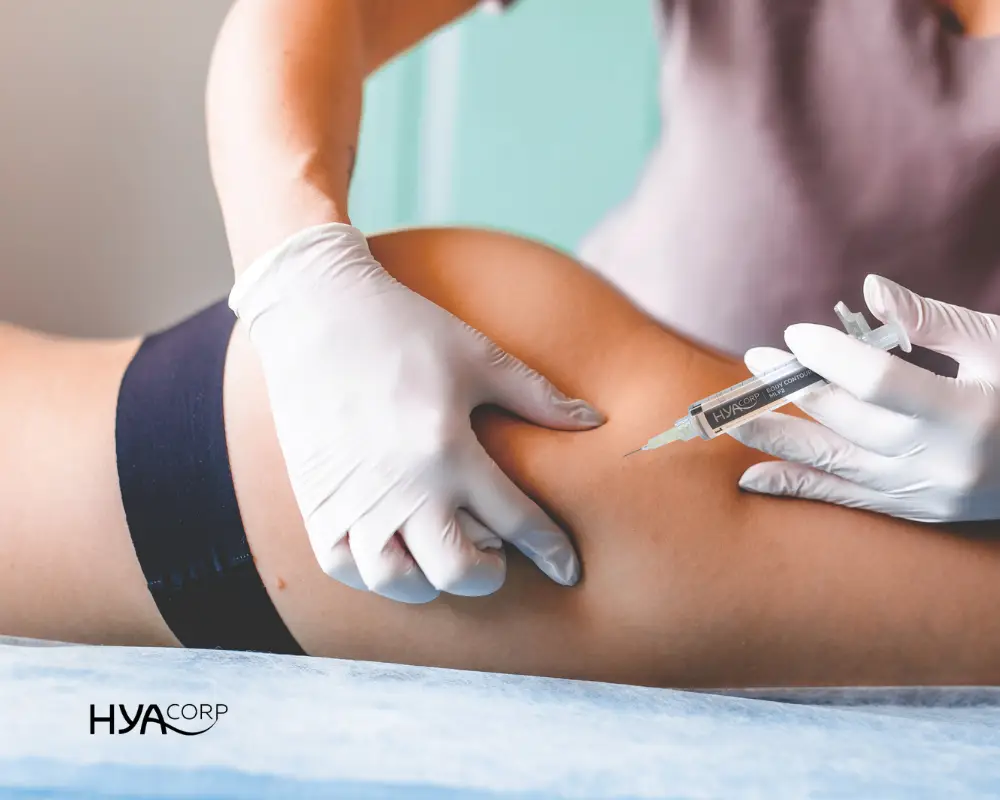



When considering body fillers, one of the first questions you are likely to ask is also one of the most important: how long do body fillers last?
The simple answer is that there is no single timeline that applies to everyone.
Hyaluronic acid fillers are designed to provide temporary results, with the body gradually breaking down the injected HA over time. How long those results remain visible can depend on several factors, from the product used and the area treated to your metabolism, lifestyle, and even how much movement the area experiences.
For HYAcorp body fillers, HYAcorp MLF1 and HYAcorp MLF2 can provide results for up to 18 months, although individual results may vary.
But why might the same filler last differently from one person (or one treatment area) to another?
Understanding what influences body filler longevity can help you have more realistic expectations about your treatment, results and potential maintenance over time.
How Do Hyaluronic Acid Body Fillers Work?
Before looking at how long fillers last, it helps to understand what happens after they are injected.
Hyaluronic acid, commonly known as HA, is a substance naturally present in the human body. In aesthetic medicine, specially formulated hyaluronic acid gels can be injected into selected areas to restore volume, refine contours and provide structural support.
Unlike permanent implants, hyaluronic acid fillers are biodegradable. This means the material is gradually broken down and absorbed by the body over time.
However, not every HA filler is formulated in the same way.
Fillers can differ in their HA concentration, degree of cross-linking, particle size, viscosity, rheological properties and intended treatment area. These characteristics influence how a filler behaves once it has been placed within the tissue and can also contribute to how long its effects remain visible.
This is particularly important when moving from facial fillers to body fillers.
Do Body Fillers Last Longer Than Facial Fillers?
Facial and body procedures involve very different anatomical environments. Areas of the body can involve larger treatment areas, different tissue characteristics, greater mechanical pressure and significantly more movement than many facial indications.
For this reason, fillers intended for larger body areas need to be formulated with those demands in mind.
HYAcorp MLF1 and HYAcorp MLF2, for example, are biphasic hyaluronic acid fillers specifically designed for body contouring rather than facial applications.
Their cross-linked HA particles are suspended within non-cross-linked hyaluronic acid, and the products have been developed with the particle size and physical properties required for their respective body indications.
Choosing a filler specifically designed for the treatment area is therefore an important part of both planning and achieving appropriate, long-lasting results.
How Long Do HYAcorp Body Fillers Last?
HYAcorp MLF1 and HYAcorp MLF2 can provide results for up to 18 months.
This does not mean that every HYAcorp result will look exactly the same for 18 months or that the filler suddenly disappears at that point.
HA fillers are gradually broken down by the body. As this happens, the volume and contour created by the procedure may progressively reduce. The exact duration can vary considerably between individuals.
Two patients treated with the same HYAcorp product may experience different longevity because the filler exists within a living, moving body. Anatomy, metabolism, movement, injection technique and lifestyle all contribute to how the result evolves.
This is why “up to 18 months” should be viewed as a potential duration rather than a guaranteed timeline for every treatment.
What Affects Body Filler Longevity?
Several factors can influence how long hyaluronic acid body fillers last.
Understanding these variables also explains why it is difficult to predict an exact duration before a consultation and treatment.
1. The Area Being Treated
Where filler is placed can make a significant difference to its longevity.
Some areas of the body experience considerable movement, pressure and mechanical stress throughout the day. Walking, running, sitting and exercising all create different forces across the tissues.
Fillers injected in areas experiencing greater movement may not last as long as filler placed in less active areas. The same product can therefore behave differently depending on where and how it is being used.
This is one reason area-specific planning matters rather than assuming every filler treatment will follow the same timeline.
2. Your Metabolism
Your body naturally breaks down hyaluronic acid, and the rate at which this happens differs from person to person.
Metabolic and biological factors can influence how the body processes hyaluronic acid, contributing to variations in filler longevity from one person to another.
Metabolism is not something that can be precisely controlled to make filler last for a specific period, which is why longevity estimates should always allow for individual variation.
3. The Product Being Used
The properties of the filler itself matter. Cross-linking, particle size, HA concentration and rheological characteristics can all influence how an injectable filler behaves within the tissue.
HYAcorp fillers are developed specifically for body contouring and use a biphasic HA structure. They are also manufactured using HYAcorp's Advanced Thixotropic Technology (ATT).
ATT allows the gel to become less viscous under pressure during injection and immediately return to its original viscosity once that pressure is removed. In addition to supporting easier injection without altering the gel’s physico-chemical characteristics, ATT helps delay the degradation of the hyaluronic acid gel.
Product choice should therefore be based on more than simply choosing a hyaluronic acid filler. The formulation should be appropriate for the area and the type of correction being performed.
4. HYAcorp MLF1 vs MLF2
Within the HYAcorp range, HYAcorp MLF1 and HYAcorp MLF2 are designed for different treatment requirements.
HYAcorp MLF1 is a cross-linked, biphasic HA filler designed for contouring and volumizing smaller body areas. Its applications include the hands, calves and correction of concave deformities.
HYAcorp MLF2 has a larger particle size and is designed for larger-volume body contouring, particularly augmentation and contouring of the gluteal area.
Both are described as providing results for up to 18 months, but choosing between them is not simply about which product lasts longer.
The right product should match the treatment area, the amount and type of correction required, and the patient's anatomy. Appropriate product selection supports a treatment plan designed around the needs of the area rather than longevity alone.
READ NOW - HYAcorp & Safety: What You Need to Know Before Your Treatment
5. The Amount of Product Used
The amount of filler used can also influence how a treatment result develops and how long its effects remain noticeable.
Body contouring frequently involves different volumes from facial filler procedures because larger areas may be treated. However, more filler does not automatically mean better or longer-lasting results.
The appropriate amount should be based on the patient's anatomy, treatment area, desired correction and the practitioner's assessment.
Rather than choosing a procedure according to a predetermined number of millilitres, the volume should form part of a treatment plan.
6. Injection Technique and Placement
The product is only one part of the treatment. Injection depth, placement, distribution and technique can all affect how a filler integrates with the surrounding tissue and how the resulting contour develops over time.
Body filler procedures require detailed anatomical knowledge and an understanding of the physical characteristics of the product being used.
For this reason, treatments should be performed by an appropriately qualified and trained medical professional with experience in injectable body contouring.
A personalised treatment plan should consider not only where volume is needed, but also which product, placement and technique are appropriate for that particular anatomy.
7. Lifestyle and Activity Levels
Lifestyle is another factor that may contribute to variations in hyaluronic acid body filler results.
Areas exposed to frequent movement and pressure can behave differently from areas that remain relatively static. Your overall activity level and the way the treated area is used in everyday life can therefore influence how the treatment evolves.
This does not mean you should change your normal lifestyle simply to preserve filler.
Instead, it reinforces why longevity should be viewed individually. Your practitioner can explain what to expect based on the area being treated and provide appropriate guidance for returning to exercise and other activities following treatment.
8. Aftercare
What happens immediately after a procedure also matters.
Your practitioner may recommend temporarily avoiding strenuous exercise, excessive pressure, intense heat or other activities depending on the treatment performed.
Following these instructions gives the treated area the appropriate conditions during the initial post-treatment period.
Aftercare recommendations can vary according to the treatment area, injection technique and patient, so always follow the guidance provided by your treating medical professional rather than relying on general instructions online.
Do Body Fillers Gradually Disappear?
Yes. Hyaluronic acid fillers do not remain unchanged indefinitely.
HYAcorp body fillers are 100% biodegradable, meaning the HA is gradually broken down by the body over time. This process is progressive rather than an overnight change.
As the filler is broken down, the added volume and contour may gradually become less noticeable. How quickly this happens will depend on many of the factors discussed above, including treatment area, metabolism, lifestyle, and individual tissue response.
This gradual process is one of the reasons it is useful to evaluate your results over time rather than expecting one fixed appearance throughout the entire lifespan of the treatment.
How Can You Tell When Your Body Filler Is Wearing Off?
Because HA fillers break down progressively, there is not necessarily one specific moment when a treatment has “worn off.”
Instead, you may gradually notice that some of the added volume or contour has reduced and that the area is moving closer to its pre-treatment appearance.
This is also why photographs taken before treatment and during follow-up appointments can be useful. Changes that happen slowly can be difficult to assess when you see your body every day.
If you are unsure whether your results have changed or whether another treatment may be appropriate, an assessment with your practitioner can provide a more objective comparison.
When Should You Consider a Body Filler Touch-Up?
There is no universal schedule for body filler maintenance. A follow-up or additional treatment should depend on how your results have developed, whether your aesthetic goals have changed and whether further treatment is appropriate.
Some patients may consider maintenance as the effects gradually reduce, while others may choose not to have another procedure.
Rather than scheduling treatment solely according to a date on the calendar, it is more useful to assess the area itself.
Your injector can review the remaining volume, contour, tissue characteristics, and overall result before recommending whether any additional treatment is needed.
Can You Make Body Fillers Last Longer?
There is no reliable way to guarantee that a filler will last for a particular number of months. Many of the factors affecting longevity, such as metabolism, anatomy, and natural tissue response, are individual.
The most important steps are therefore not ‘hacks’ for making filler last longer, but making informed choices from the beginning:
- Choose an appropriately qualified medical professional.
- Use a filler designed for the intended treatment area.
- Follow the treatment plan created for your anatomy and goals.
- Follow your practitioner's aftercare instructions.
- Attend recommended follow-up appointments.
- Discuss changes in your results before deciding on additional treatment.
Long-lasting results begin with an appropriate product and treatment plan, not simply with trying to preserve as much filler as possible.
Long-Lasting Results Start With the Right Approach
Long-lasting results are an important consideration when choosing a body filler, with product selection and the right approach both contributing to how those results develop over time.
The right filler brings together longevity with product suitability, proportion, placement and how well the result complements your existing anatomy.
HYAcorp MLF1 and MLF2 are body-specific hyaluronic acid fillers designed for different contouring requirements, with results that can last up to 18 months depending on individual factors.
Ultimately, the goal should be a treatment plan that makes sense for your anatomy, your treatment area and your aesthetic goals — with realistic expectations about how those results may change over time.
Considering HYAcorp body fillers or want to learn more about how long results may last? Contact us to learn more about HYAcorp treatments and connect with the appropriate team in your country.
Frequently Asked Questions About Body Filler Longevity
How long do body fillers last?
The duration of body fillers varies depending on the filler used, treatment area, patient metabolism, injection technique, lifestyle and individual tissue response. HYAcorp MLF1 and MLF2 can provide results for up to 18 months, although individual results may vary.
How long do HYAcorp body fillers last?
HYAcorp MLF1 and HYAcorp MLF2 are described as providing results for up to 18 months. The actual duration can vary depending on factors such as the treatment area, amount of product used, metabolism, lifestyle and injection technique.
How long does HYAcorp MLF2 last in the buttocks?
HYAcorp MLF2 is designed for augmentation and contouring of the gluteal area and can provide results for up to 18 months. Individual longevity varies, particularly because the gluteal region is exposed to movement and pressure from activities such as walking, exercising and sitting.
Does HYAcorp MLF1 last as long as MLF2?
Both HYAcorp MLF1 and MLF2 are described as providing results for up to 18 months. However, they are intended for different body-contouring applications, and actual longevity depends on the treatment area and individual factors rather than product choice alone.
Are HYAcorp body fillers permanent?
No. HYAcorp MLF1 and MLF2 are hyaluronic acid-based body fillers and are 100% biodegradable. The HA is gradually broken down by the body, meaning the results are temporary.
What makes body filler dissolve faster?
There is no single factor that determines how quickly a body filler breaks down. Treatment area, movement, metabolism, product characteristics, injection technique, lifestyle and individual tissue response can all influence filler longevity.
Does exercise make body filler wear off faster?
Areas that experience greater movement may not retain filler results for as long as less active areas. However, this does not mean patients should avoid exercise long-term to preserve their filler. Follow your practitioner's post-treatment instructions and discuss your usual activity levels during your consultation.
Does the amount of filler affect how long it lasts?
The amount of product used can influence treatment results and duration, but using more filler does not automatically guarantee longer-lasting or better results. The appropriate volume should be determined according to the treatment area, anatomy and individual treatment plan.
How do I know when my body filler is wearing off?
Fillers typically break down gradually. You may notice that the additional volume or contour becomes less pronounced over time and the treated area begins moving closer to its pre-treatment appearance. Follow-up photographs and practitioner assessments can help evaluate these changes.
How often should HYAcorp body fillers be topped up?
There is no standard maintenance schedule that applies to every patient. Whether or when additional treatment is appropriate depends on how your results have developed, the area treated, your anatomy and your aesthetic goals. A qualified practitioner should assess the area before recommending further treatment.
What affects hyaluronic acid filler longevity?
Factors that may affect HA filler longevity include the product formulation, treatment area, injection technique, amount of filler used, patient metabolism, movement and pressure in the treated area, lifestyle and individual tissue response.
Why do body filler results vary from person to person?
Every patient's anatomy, metabolism, lifestyle and tissue characteristics are different. The treatment area, product, amount used and injection technique can also vary, which is why two people receiving hyaluronic acid body fillers may experience different durations and results.

.webp)