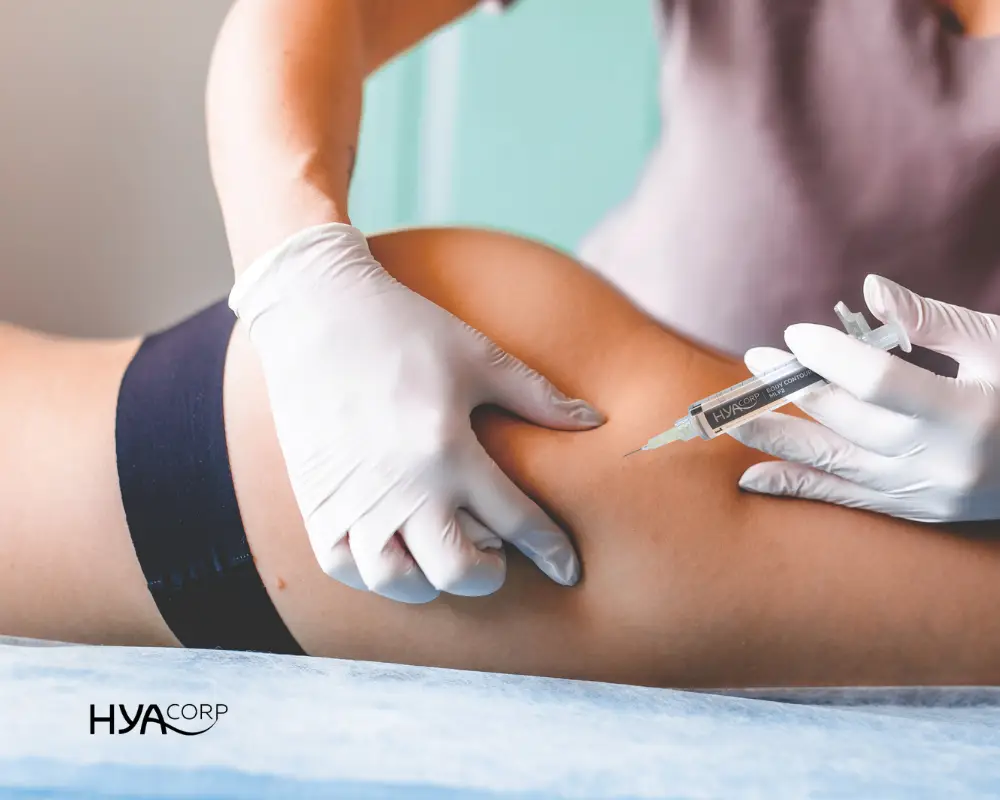
In aesthetic medicine, results are no longer measured by volume alone. Today, patients are looking for treatments that feel natural, move comfortably, and support their body’s own proportions. Practitioners, on the other hand, need injectable products that offer control, stability, predictable placement, and long-term performance.
This is especially important in body contouring, where fillers are exposed to movement, pressure, and larger treatment areas. A filler not only needs to create volume, but it also needs to behave well inside the tissue, support the intended shape, and maintain a refined contour over time.
That is why the science behind the filler becomes just as important as the result itself.
HYAcorp, developed by BioScience GmbH, is a specialized line of hyaluronic acid body fillers designed for non-surgical body contouring, volume restoration, and corrective refinement. One of the key technologies behind its performance is Advanced Thixotropic Technology, also known as ATT.
While the term may sound highly technical, the concept is simple: HYAcorp fillers are designed to facilitate their injection, then return to their original stable structure once placed in the tissue.
For practitioners, this supports a more controlled application. For patients, it helps create aesthetic results that feel balanced, refined, and aligned with their natural silhouette.
What Is Advanced Thixotropic Technology?
To understand Advanced Thixotropic Technology, it helps to first understand thixotropy.
Thixotropy describes the way certain materials become more fluid when pressure or movement is applied, then return to a thicker, more stable state when left at rest. A simple example is honey. When honey is still, it feels thick and slow-moving, but when stirred, it becomes easier to pour. Once it settles again, it returns to a thicker consistency.
A similar principle applies to thixotropic fillers.
During injection, the filler experiences pressure as it passes through the syringe, cannula, or needle. With HYAcorp’s Advanced Thixotropic Technology, the gel becomes less viscous under this injection force, allowing it to flow more smoothly. Once the pressure is removed and the filler is placed within the tissue, the gel returns to its original viscosity.

This matters because body contouring requires both injectability and support. A filler that is too stiff may be difficult to place smoothly. A filler that is too fluid may not provide enough structure. ATT helps create a balance between these two needs by allowing the gel to adapt during injection and regain stability after placement.
Why Viscosity Matters in Body Fillers
Viscosity refers to how thick or fluid a gel is. In aesthetic medicine, this affects how easily the product can be injected, how it spreads, how it holds shape, and how it integrates within the tissue.
For facial fillers, smaller volumes are usually used in more delicate areas. But body fillers have different demands. Areas such as the buttocks, hips, calves, and hands are often exposed to more movement, pressure, and mechanical stress. These areas may also require higher volumes and stronger structural support. This is why body-specific HA fillers are important.
HYAcorp fillers are designed with the body in mind. Their formulation supports volume restoration, contour correction, and projection in areas where a standard facial filler may not provide the same level of support.
This means that practitioners can have greater confidence when working in larger or more complex treatment areas. It also means the product has been developed for body contouring rather than adapted from a facial indication.
The Practitioner Advantage: Flow, Control, and Precision
Every experienced injector understands that product behavior affects treatment quality.
A filler may have strong volume capacity, but if it is difficult to inject, unpredictable under pressure, or inconsistent in tissue, it can make the treatment more challenging. This becomes even more important in aesthetic procedures because larger treatment areas require accuracy, planning, and smooth product placement.
ATT supports the practitioner by improving the balance between flow and structure. During injection, the gel becomes easier to handle under pressure. This may support smoother delivery and more controlled placement. Once placed, the gel returns to a more stable structure, helping the practitioner work toward the intended contour.
This is particularly relevant for procedures such as:
- Gluteal enhancement
- Hip dip correction
- Calf contouring
- Hand rejuvenation
- Corrective body contouring
- Smoothing concave deformities
- Post-procedure contour refinement
In these cases, accuracy matters. The goal is not just to add volume, but to place the right amount of filler in the right area, at the right depth, using the right technique.
ATT supports this by helping the filler move when injection pressure is applied and stabilizing once positioned within the tissue.
The Patient Benefit: Results That Feel Balanced and Refined
Patients may not always ask about rheology, viscosity, or thixotropy. But they do care about how the result looks and feels.
They want a result that feels natural to them. They want smoother contours without an artificial appearance. They want an enhancement that supports their natural silhouette rather than overpowering it.
This makes the physical behavior of the filler a very important factor. Because HYAcorp fillers are designed to regain stability after injection, they can support controlled contouring and help maintain the intended shape. This contributes to results that feel refined, balanced, and suited to the patient’s anatomy.
For patients considering non-surgical body contouring, this can be reassuring. It shows that treatment is not only about adding filler, but about using a product engineered to perform in the body.
A well-balanced result is not accidental. It comes from the combination of product quality, treatment planning, anatomical knowledge, and skilled technique.
How ATT Supports Filler Stability
One of the key challenges with hyaluronic acid fillers is degradation. HA naturally breaks down over time in the body. This is part of what makes HA fillers temporary and adaptable. However, for body contouring, where larger areas and higher volumes may be involved, product stability becomes an important factor in long-term treatment planning.
Advanced Thixotropic Technology is designed to support the gel’s structure during and after injection.
When a filler is forced through a syringe, it is exposed to mechanical stress. If the gel structure is disrupted during this process, it may affect the way the product behaves once placed in the tissue. ATT helps the gel withstand injection pressure while maintaining its physical and chemical properties.
This means the filler is designed to remain consistent from syringe to tissue.
This supports more predictable treatment planning and contributes to results that are shaped with stability, proportion, and control in mind.
Preserving Molecular Integrity
In filler science, molecular integrity refers to the stability and structure of the gel itself. A high-quality filler should not lose its essential properties during injection. It should be able to pass through the delivery system smoothly while maintaining the characteristics that allow it to support volume, contour, and tissue integration.
ATT helps preserve this integrity by allowing the gel to respond to pressure without losing its intended structure. This is especially important in high-volume body contouring, where the filler must be both flexible and supportive. If the gel is too rigid, it may feel unnatural. If it is too weak, it may not provide the desired lift or contour. This technology also helps support a middle ground: a filler that can be injected with control and maintain its structure after placement.
This is one of the reasons why product engineering matters in modern aesthetics. The best results are not only shaped by the hands of the practitioner, but they are also shaped by the science of the product.
HYAcorp and the BioScience Standard
Behind HYAcorp is BioScience GmbH, a German manufacturer specializing in hyaluronic acid-based aesthetic solutions.
The brand’s approach is rooted in product engineering, manufacturing quality, and medical-grade performance. HYAcorp has become known for its focus on body fillers, especially through its products, HYAcorp MLF1 and MLF2, which include formulations designed for different body areas and treatment goals.
HYAcorp’s filler portfolio allows practitioners to select the product according to the treatment area, volume needs, and correction goals. This supports a more personalized approach to body contouring, where the product is chosen based on anatomy rather than a one-size-fits-all method.
ATT and the Future of Precision Body Contouring
The future of aesthetic medicine is moving toward more intelligent, personalized, and science-led treatments.
Patients are becoming more informed. They want to understand not only what a treatment can do, but how it works and why it is suitable for their body. At the same time, practitioners are looking for technologies that support better control, improved safety planning, and more predictable outcomes.
ATT fits directly into this shift as it reflects a modern approach to filler design, where performance is not defined by thickness alone. Instead, the focus is on how the gel responds to pressure, how it behaves after placement, how it supports natural movement, and how it contributes to the overall treatment result.
In non-surgical body contouring, fillers must be strong enough to support contour, but refined enough to look and feel natural. They must allow controlled injection while remaining stable in the tissue. They must support volume while respecting the patient’s anatomy.
This is the balance that HYAcorp’s patented manufacturing process is designed to support.
Where Science Meets Aesthetic Confidence
At its best, aesthetic medicine should feel seamless. The patient should not see the technology behind the treatment. They should see balance, proportion, and confidence.
But behind a refined, longer-lasting aesthetic outcome is science. There is material science, there is rheology, and there is product engineering. There is also injector skill, anatomical understanding, and careful planning. Every part of the process contributes to the final result.
HYAcorp’s Advanced Thixotropic Technology represents this connection between science and artistry. It supports the practitioner’s technique while helping patients achieve refined results that feel aligned with their natural silhouette.
Want to Learn More about HYAcorp?
Whether you are a patient exploring non-surgical contouring or a practitioner looking for advanced HA body fillers designed for precision and performance, HYAcorp offers a specialized approach backed by science-led product engineering.
To learn more about how HYAcorp can support your aesthetic goals or clinical practice, contact us today.
FAQs:
What is Advanced Thixotropic Technology?
Advanced Thixotropic Technology (ATT) is a technology used in HYAcorp fillers that allows the gel to become more fluid under injection pressure and then return to its original stable viscosity once placed in the tissue. This supports smoother injection and stable contouring performance.
What does thixotropic mean in fillers?
In fillers, thixotropic means the gel can temporarily become less viscous when pressure is applied. Once the pressure stops, the gel returns to a more stable state. This is useful in aesthetic treatments because it helps balance injectability with structural support.
Why is viscosity important in body fillers?
Viscosity affects how a filler flows, spreads, and holds shape inside the tissue. In body contouring, viscosity is important because treated areas often need more support, higher volume, and greater resistance to movement compared to facial areas.
How does HYAcorp ATT support natural-looking results?
HYAcorp’s ATT technology helps the gel flow during injection and stabilizes after placement. This supports controlled contouring, precise placement, and results that are designed to look and feel natural when performed by a qualified practitioner.
Are HYAcorp fillers suitable for body contouring?
Yes. HYAcorp body fillers are specifically designed for body contouring, volume restoration, and corrective refinement. They are commonly associated with areas such as the buttocks, hips, calves, hands, and concave deformities.
What is the difference between body fillers and facial fillers?
Body fillers are designed to meet the anatomical needs of larger, more mobile areas. They often require different rheological properties, stronger support, and higher volume capacity. Facial fillers are typically designed for smaller, more delicate treatment areas.
How long do HYAcorp body filler results last?
HYAcorp body fillers are commonly positioned for contouring outcomes that may last up to 18 months, although results vary depending on the treatment area, patient metabolism, lifestyle, and technique.
Why choose HYAcorp for non-surgical body contouring?
HYAcorp offers a specialized line of hyaluronic acid body fillers supported by Advanced Thixotropic Technology, body-specific formulations, and a focus on precision-led contouring. It is designed for practitioners who want control and patients seeking refined, natural-looking body contouring results.
.webp)