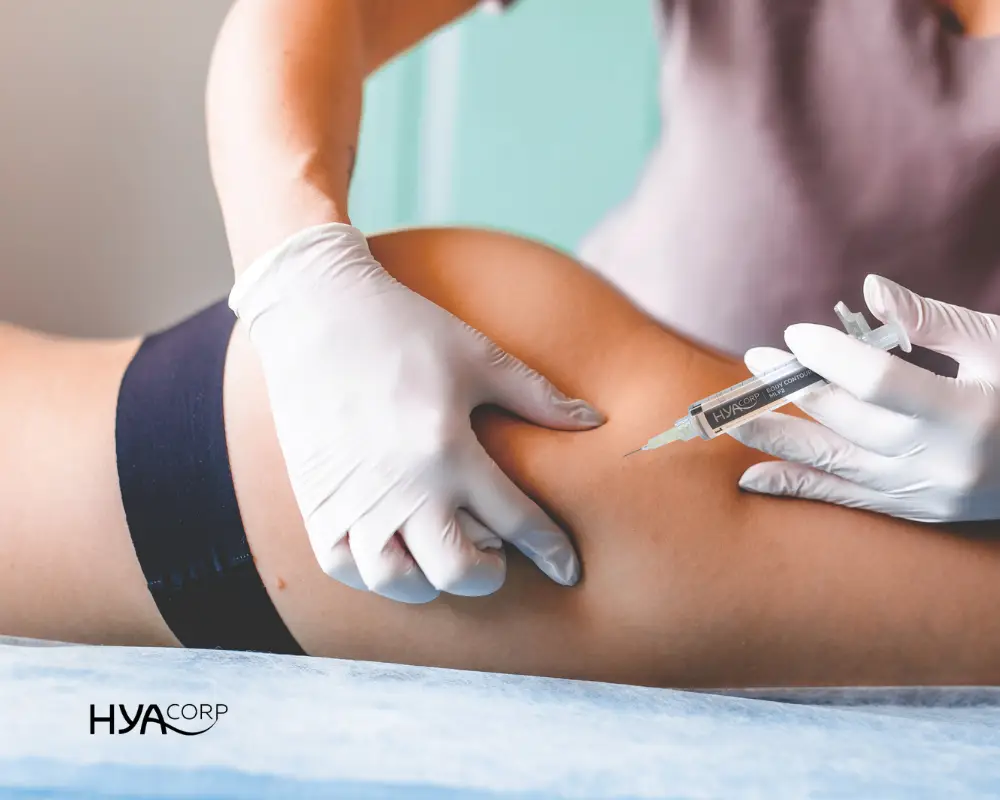



Beyond the Body-Face Disconnect in Aesthetic Medicine
One of the most common questions in aesthetic medicine today is: Can facial fillers be used on the body?
The short answer is no, because they are not designed for the same purpose.
While both body and facial fillers are often made from hyaluronic acid (HA), they are formulated very differently. Facial fillers are created to treat fine lines, wrinkles, lips, and small-volume areas in the face. They are softer, more delicate, and intended for thinner tissue with minimal pressure.
The body, however, is structurally different.
Body tissue is denser. It carries more weight. It experiences higher movement and pressure, especially in areas like the buttocks, hips, and thighs. Because of this, body fillers must be stronger, more stable, and capable of maintaining shape in high-volume treatments.
This is why dermal fillers designed specifically for the body are essential for safe and effective contouring. This is where HYAcorp sets itself apart in the field of aesthetics.
Why Specialized Body Fillers Matter
The body requires a completely different approach compared to the face. Areas such as the hips, buttocks, calves, and thighs involve thicker tissue, higher mobility, and significantly larger treatment volumes.
Using fillers that were originally designed for fine facial wrinkles in these regions can compromise both safety and aesthetic outcome.
Using a facial filler for body contouring can lead to:
- Reduced longevity
- Insufficient lift or structure
- Increased risk of migration
- Puffy or less defined results
Specialized body fillers, like those from HYAcorp, are formulated using biphasic, cross-linked hyaluronic acid technology. This structure provides enhanced stability, lift, and durability. These are qualities that are essential for non-surgical body lift procedures and volume restoration.
Facial fillers focus on softness and subtlety. Body fillers must deliver structure and endurance.
This distinction is not for marketing, but rather an anatomical reality.
What Are the Risks of Using Facial Fillers on the Body?
While off-label use exists in many areas of medicine, using fillers designed for the face in high-volume body treatments can come with real limitations.
Facial fillers are created for more delicate areas like the lips, cheeks, and fine lines. The gluteal area, such as the buttocks and hips, places far greater mechanical stress on injected material. When products not engineered for body applications are used in these regions, several concerns may arise, such as:
1. FILLER MIGRATION
One of the biggest risks of using facial fillers for buttocks or hip augmentation is migration. Softer gels may shift over time in high-mobility areas, potentially affecting symmetry and long-term results.
2. LACK OF STRUCTURAL SUPPORT
Facial fillers are typically lower density and designed for subtle refinement. In body contouring procedures such as non-surgical buttock augmentation or hip dip correction, stronger structural support is required to maintain lift and shape. Without it, results may lack definition.
3. SHORTER DURATION
Because facial fillers are not formulated for the pressure and movement of larger zones, they may break down more quickly. Patients seeking long-lasting body filler results may find that off-label products do not provide the expected durability.
4. PUFFY OR UNDEFINED RESULTS
Without the appropriate rheological strength, high-volume treatments can appear overly soft or less sculpted. Instead of achieving a structured, contoured silhouette, the outcome may look less refined.
Why Specialized Body Fillers Improve Safety, Structure, and Results
When it comes to non-surgical body contouring, product design is important.
Dedicated fillers are engineered specifically for high-volume treatment areas such as the buttocks, hips, and calves. These regions experience greater pressure, movement, and tissue density than the face, which means they require a filler with enhanced structural performance.1
Specialized fillers provide:
- Greater gel stability in high-mobility areas
- Stronger lift capacity for gluteal augmentation and hip contouring
- Controlled, precise volume placement
- Longer-lasting results in body applications
- Improved body contouring safety through anatomical compatibility
This is why the conversation around body filler vs facial filler continues to grow. When patients search questions like “Is facial filler safe for buttocks?” or “What is the best filler for gluteal augmentation?”, they are ultimately asking about durability, structure, and risk.
The answer lies in formulation.
Body contouring requires fillers designed for the body, not just products adapted from facial treatments. Using specialized fillers significantly improves structural integrity, longevity, and predictability while reducing complications associated with off-label use.
Precision in aesthetic medicine is not optional but an essential aspect of aesthetic treatments.
The HYAcorp Difference: Engineered for the Body, Not Adapted for It
When discussing body contouring safety and long-term results, formulation is everything.
HYAcorp stands apart because it was developed specifically for body applications. They are not repurposed facial injectables used off-label. Instead, they are engineered to meet the structural, mechanical, and anatomical demands of high-volume treatments. This difference begins at the molecular level.
1. NON-ANIMAL ORIGIN HYALURONIC ACID
HYAcorp uses high-purity, non-animal origin hyaluronic acid (HA), making it both biocompatible and aligned with the growing demand for vegan-friendly aesthetics and clean medical standards.
Because the HA is not derived from animal sources, the risk of allergic reactions is minimized, and product consistency remains high. This supports improved tissue compatibility and predictable performance.
For patients and practitioners alike, this translates into:
- Reduced allergy risk
- Cleaner aesthetic formulations
- Sustainable, ethically aligned treatment options
- Greater confidence in material purity
2. PIONEERING CROSS-LINKED HA WITH ADVANCED THIXOTROPIC TECHNOLOGY
HYAcorp incorporates advanced double cross-linking processes combined with thixotropic technology, which allows the gel to adapt under needle/cannula pressure while maintaining structural integrity once injected.
This innovation enhances:
- Structural stability in high-volume areas
- Controlled, precise filler placement
- Improved lift capacity
- Natural elasticity with long-lasting support
- Stable contouring in high-mobility zones such as the buttocks and hips
The biphasic hyaluronic acid structure ensures balanced particle distribution, providing firmness where needed while preserving flexibility and movement.
This balance between strength and adaptability allows the filler to integrate smoothly with body tissue while maintaining durability.
3. PROVEN SAFETY & BIOCOMPATIBILITY
With over 20 years of constant innovation and development, HYAcorp body fillers are:
- 100% biodegradable
- Fully biocompatible
- Designed for minimal downtime
- Engineered for long-lasting results2
Patients can typically return to normal activities within days, making these treatments compatible with modern, active lifestyles.
Long-term biodegradability ensures that the product gradually and safely integrates and breaks down within the body over time, maintaining safety without compromising performance.
4. GERMAN ENGINEERING AND CE-CERTIFICATION STANDARDS
Manufactured under stringent European quality controls, HYAcorp has carried CE certification since 2006 (CE 2409), reflecting regulatory compliance and medical-grade reliability.
German engineering is synonymous with precision and durability, which are qualities that matter deeply in aesthetic medicine.
In a market where product origin and formulation standards directly impact patient outcomes, choosing a CE-certified filler designed specifically for body contouring is a much-needed safeguard.
HYAcorp MLF1 vs. HYAcorp MLF2: Purpose-Built Precision
HYAcorp’s portfolio includes two advanced formulations designed for different contouring needs.
Designed for precision and moderate volume correction.
Commonly used for:
- Calf contouring
- Hand rejuvenation
- Fine contour refinements
MLF1 delivers controlled enhancement with smooth tissue integration.
Engineered for high-volume contouring and commonly used for:
- Gluteal augmentation
- Hip dip correction
MLF2 offers stronger lift capacity and durability while maintaining natural movement.
Together, these products allow practitioners to tailor treatment based on anatomical demands and aesthetic goals.
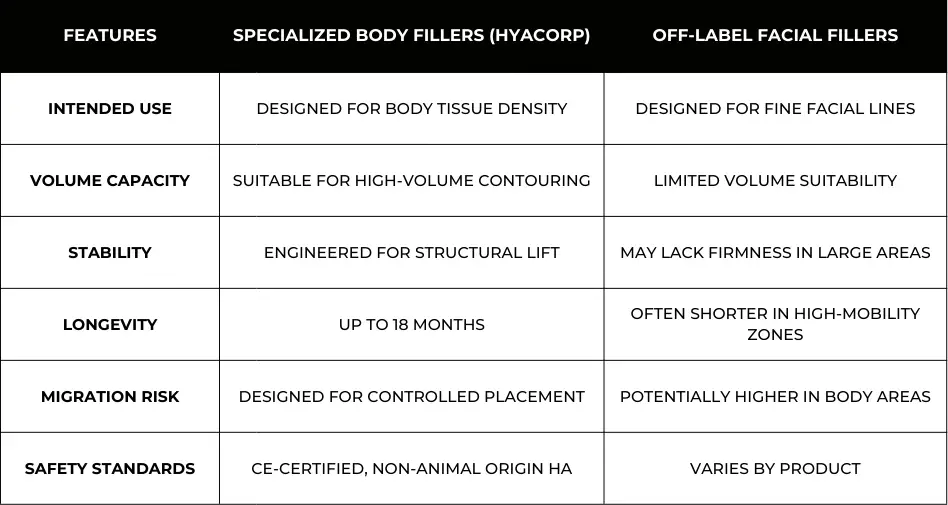
Pros & Cons: Dedicated Body Fillers vs. Off-Label Facial Fillers
Final Thoughts
Precision is no longer optional in modern aesthetic medicine.
The difference between a facial filler and a specialized body filler is not minor. It is structural, anatomical, and directly tied to safety and long-term results. As non-surgical contouring and non-surgical lift procedures continue to rise in demand, choosing fillers specifically engineered for body applications is essential for predictable, durable outcomes.
Body contouring should be approached with the same level of care and intention as any medical treatment. Using products designed for body anatomy improves structural support, longevity, and overall treatment confidence.
If you would like to learn more about how HYAcorp’s dermal injectables are designed for safe, structured, and natural-looking contouring, contact us to explore your options or schedule a consultation.
Because when it comes to your body, informed choices make all the difference.
Frequently Asked Questions
What are the benefits of non-animal origin hyaluronic acid fillers?
Non-animal origin hyaluronic acid fillers reduce allergy risk, improve product purity, and enhance biocompatibility. They align with vegan-friendly and clean aesthetic standards while maintaining high safety and performance levels for body contouring treatments.
Can facial fillers be used on the buttocks?
Facial fillers are not designed for high-volume body contouring. The buttocks and hips require specialized fillers with greater structural support and durability. Using those made specifically for body anatomy improves safety, stability, and long-lasting results.
What is the difference between body fillers and facial fillers?
Body fillers are engineered for dense, high-mobility tissue and larger treatment areas. Facial fillers are formulated for delicate, low-pressure areas such as lips and fine lines. The ones designed for the body provide stronger lift, improved stability, and better longevity for procedures like gluteal augmentation.
How long do HYAcorp body fillers last?
HYAcorp MLF1 and MLF2 can last up to 18 months. Duration depends on the treatment area, metabolism, injection technique, lifestyle factors, and individual tissue response.
Is HYAcorp safe for body contouring?
Yes. HYAcorp fillers are CE-certified and manufactured under strict European medical standards, with a proven safety record spanning over 20 years in the market. They are biodegradable, biocompatible, and specifically designed for safe, high-volume body applications.
What is biphasic hyaluronic acid technology?
Biphasic hyaluronic acid technology allows controlled particle distribution within the filler gel. This improves structural support, lift capacity, and stability in high-mobility areas such as the buttocks and hips.
References
- Fontenete S, Alfertshofer M. Rheological and Physicochemical Properties of Hyaluronic Acid Fillers for Body Contouring: Clinical Implications and Anatomical Considerations. J Cosmet Dermatol. 2026;25(2):e70553.
- Crabai P, Marchetti F, Santacatterina F, Fontenete S, Galera T. Nonsurgical Gluteal Volume Correction with Hyaluronic Acid: A Retrospective Study to Assess Long-term Safety and Efficacy. Plast Reconstr Surg Glob Open. 2024;12(5):e5792.

.webp)