Safety Is the Foundation
When considering any aesthetic treatment, the first question should not only be, “How will it look?” It should also be, “How safe is it?”
With HYAcorp, safety begins long before the treatment takes place. It starts with the quality of the hyaluronic acid, continues through the product’s formulation and manufacturing process, and is supported by the regulatory standards it meets before reaching a clinic.
Every part of this process matters. For practitioners, it means working with a CE-certified body filler developed for professional use in non-surgical body contouring. For patients, it means choosing a treatment option designed with biocompatibility, quality, and clinical confidence in mind.
This blog explains the key safety factors behind HYAcorp body fillers, from its formulation and certification to practitioner training and patient suitability, so you can better understand what to know before treatment.
What Is HYAcorp Made Of?
HYAcorp is a hyaluronic acid (HA) body filler, which means its main ingredient is a substance the body already recognizes. Hyaluronic acid is naturally found in the skin, connective tissue, and joints, where it helps maintain hydration, support, and tissue resilience.
Because HA is naturally present in the body, it is generally well-tolerated. In most cases, allergy testing is not required, but patient suitability should always be assessed by a qualified practitioner before treatment.
What makes this formulation important is that its HA is derived from a non-animal source and produced through a controlled bacterial biosynthesis process. This helps reduce the likelihood of allergic or inflammatory response and supports a more biocompatible formulation for professional body contouring treatments.
For patients, this means choosing a product designed with tissue compatibility in mind. For practitioners, it provides a medical-grade HA body filler developed for use in larger, body-specific treatment areas.
Biphasic Technology: Designed for the Body, Not Just the Face
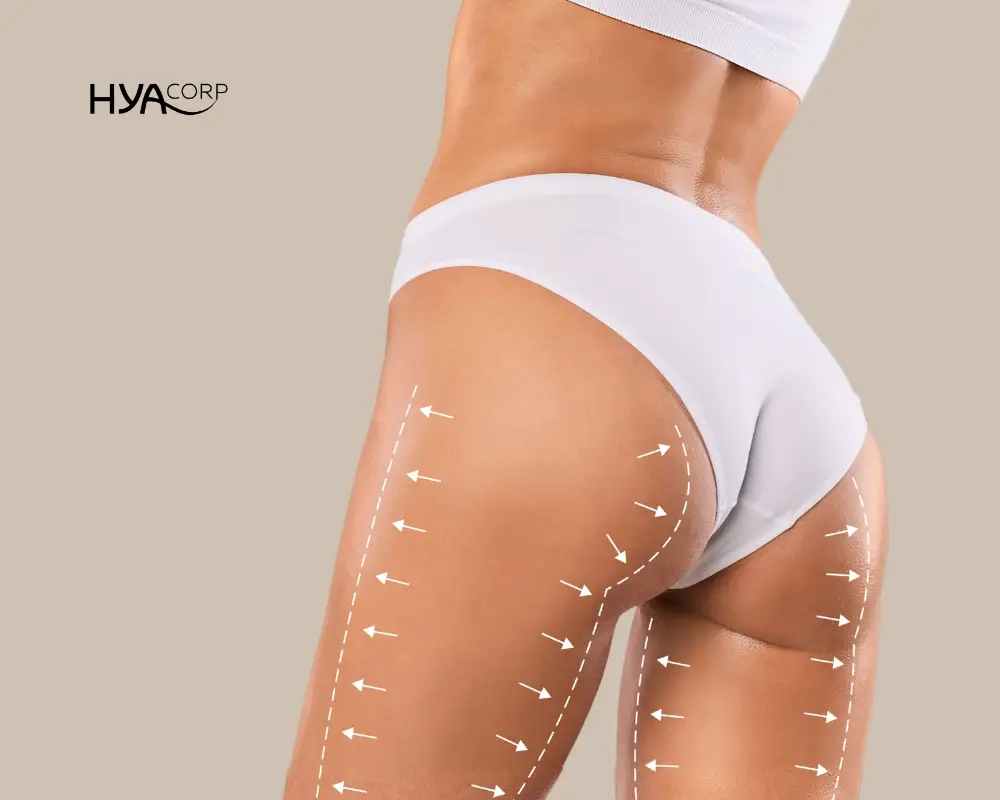
Most people are familiar with facial fillers, but body contouring requires a different level of support. Areas such as the buttocks, hips, calves, and hands have different tissue demands compared to the face. They are often exposed to more movement, pressure, and volume requirements, which is why products designed for fine lines or facial refinement may not be suitable for larger body areas.
HYAcorp was developed specifically for the body using a biphasic hyaluronic acid formulation. This means the gel is made up of two phases: cross-linked HA particles suspended in a non-cross-linked HA carrier. The cross-linked particles help provide structure, projection, and volume, while the smooth carrier phase supports easier distribution and integration within the surrounding tissue.
This biphasic architecture plays an important role in product performance. It is designed to support controlled placement, smoother distribution, and more predictable results when used with proper technique by a trained practitioner. This is especially important in larger treatment areas, where precision and anatomical understanding are essential.
Another benefit of biphasic HA technology is longevity. The cross-linked HA particles are designed to break down gradually over time, helping support longer-lasting body contouring results. HYAcorp results may last up to 18 months, depending on the treatment area, product used, patient metabolism, lifestyle, and injection technique.
BDDE: What It Is, and Why Low Levels Matter
To make hyaluronic acid body fillers longer lasting, HA is often stabilised through a process called cross-linking. This process commonly uses a chemical agent called BDDE or 1,4-butanediol diglycidyl ether. BDDE is widely used in the HA filler industry, but the amount of residual free BDDE left in the final product is an important safety consideration.
HYAcorp’s manufacturing process results in a residual free BDDE level of less than 1 ppm or 0.001 mg/ml. This places it below commonly referenced safety thresholds and supports the product’s clean formulation profile.
Why does this matter? Lower levels of residual BDDE help support biocompatibility, may help reduce the likelihood of irritation, and give practitioners greater confidence in the product’s safety profile when used correctly.
It is designed with careful attention to formulation quality, reflecting the importance of controlled manufacturing standards and a clear safety-focused profile. This emphasis on quality and consistency supports confidence in the use of a medical-grade HA body filler when used appropriately.
CE Certification: What It Means and Why It Matters
HYAcorp is classified as a Class III medical device under the European Medical Device Regulation and carries the CE mark. This is an important safety marker because Class III is the highest category for implantable medical devices in Europe and requires a strict level of regulatory review before the product can be placed on the market.
To obtain and maintain this status, the manufacturer must demonstrate that the product meets established standards for safety, performance, and quality. This includes product testing, independently audited quality management systems, and ongoing post-market surveillance to monitor performance once the product is used in real-world clinical settings.
This means HYAcorp has undergone independent regulatory assessment rather than relying solely on the manufacturer’s own internal processes. An authorised notified body evaluates the product to ensure it meets the requirements set out under European medical device regulations.
For both patients and practitioners, this regulatory approval offers reassurance that the product has been manufactured, tested, and is subject to ongoing monitoring in accordance with recognised European standards. This provides an added level of confidence when selecting a medical-grade HA body filler for professional use.
HYAcorp’s CE certification number is 2409, allowing practitioners and patients to verify its regulatory status directly.
Ongoing Research and Post-Market Commitment
Safety does not stop once a product receives certification. Ongoing quality monitoring, clinical feedback, and post-market follow-up remain important parts of responsible product development.
This means the product used in clinics today is supported not only by its original development and testing process, but also by continued evaluation in real-world clinical settings. Through post-market surveillance, clinical data, practitioner feedback, and ongoing product assessment, the manufacturer can continue monitoring safety, performance, and consistency over time.
Practitioners working with HYAcorp also have access to professional training, technical guidance, and educational resources – on the BioScience Digital Academy – that support appropriate product use and responsible injection practice.
This ongoing commitment reflects the emphasis placed on maintaining high standards of safety, quality, and clinical performance over the long term.
Minimally Invasive, Minimal Downtime
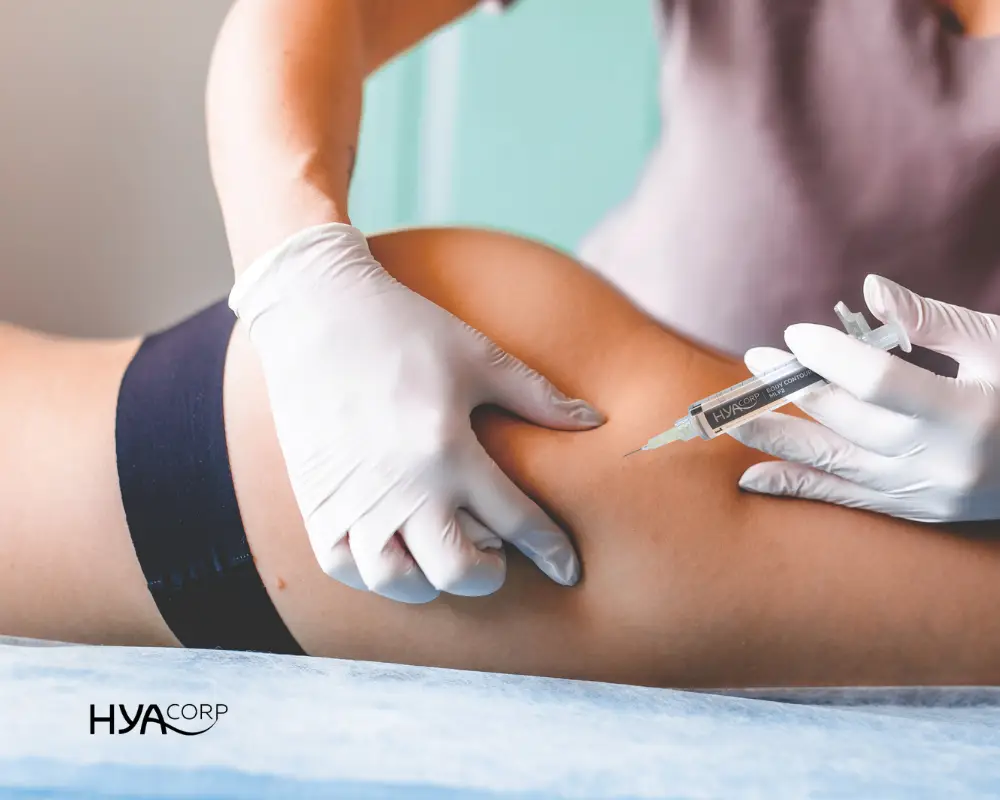
One of the practical advantages of HYAcorp is that it offers a minimally invasive, non-surgical body contouring approach. There is no need for general anaesthesia, no invasive surgery, and no lengthy downtime.
Treatments are performed in a clinical setting by a trained aesthetic practitioner. Depending on the area and technique, a cannula may be used. A cannula is a blunt-tipped instrument that can help reduce tissue trauma compared with a sharp needle when used appropriately.
After treatment, most patients may experience mild swelling, tenderness, redness, or temporary discomfort in the treated area. These effects are usually manageable with proper aftercare and often settle within 48 to 72 hours, although individual recovery can vary.
Compared with surgical body contouring, HYAcorp body filler treatments involve a different recovery profile. Because there is no surgery, no general anaesthesia, and no incision, patients avoid many of the procedural factors associated with surgical treatments, such as hospital admission, wound healing, and post-surgical scarring.
This makes HYAcorp a suitable option for patients looking for a non-surgical body contouring treatment with minimal downtime, when performed by a qualified practitioner and after proper assessment.
Can HYAcorp Be Reversed?
Yes – one of the important safety advantages of hyaluronic acid injectables is that HA can be broken down using an enzyme called hyaluronidase when clinically appropriate.
If a patient is unhappy with their result, or if adjustments are desired, a qualified practitioner may use hyaluronidase to help reduce or dissolve the HA gel. This should always be done by a trained medical professional in a clinical setting after proper assessment.
This is an important difference between HA-based body fillers and more permanent treatment options, such as implants or fat transfer. While every treatment requires careful planning and carries its own risks, the ability to adjust or dissolve HA gives an added level of flexibility.
With HYAcorp, an important principle of responsible aesthetic medicine is maintaining safety, control, and the ability to make adjustments if needed in the future.
Who Should Administer HYAcorp?
HYAcorp body fillers should only be administered by trained and qualified aesthetic practitioners. They are professional medical devices intended for clinical use and are not suitable for self-administration.
The safety of any injectable treatment depends not only on the product itself, but also on the skill, training, and judgment of the practitioner performing the procedure. A safe and effective treatment requires proper patient assessment, correct product selection between HYAcorp MLF1 and HYAcorp MLF2, precise injection technique, and the ability to recognise and manage potential complications.
This is especially important for body contouring treatments, where larger treatment areas, deeper tissue planes, and higher volumes may be involved. Body injections require specific knowledge of anatomy and technique, which can differ from facial injectable treatments.
If you are considering body filler treatments, always choose a qualified practitioner who is trained in body injection techniques and works within an appropriate clinical environment. Proper training, patient suitability assessment, and professional aftercare are essential parts of a safe treatment experience.
If you would like to learn more about HYAcorp treatments or discuss your options, please contact us for more information and guidance on the next steps
FAQs
Is HYAcorp safe for body contouring?
HYAcorp is a CE-marked Class III medical device designed for professional use in body contouring treatments. It is made with non-animal-sourced hyaluronic acid and has a low residual BDDE level. As with any injectable treatment, safety also depends on practitioner training, technique, and patient suitability.
- CE-marked Class III medical device
- CE certification number: 2409
- Made with non-animal-sourced HA
- Gradually absorbed by the body over time
What should patients expect after HYAcorp body filler treatment?
Following treatment, patients may experience a short recovery period while the treated area settles. Individual experiences vary, and practitioners will provide personalised aftercare guidance to support optimal results.
- Temporary swelling or tenderness may occur as part of the normal healing process
- Mild bruising can be expected in some cases
- Following aftercare instructions helps support recovery
- Any concerns should be discussed with a qualified healthcare professional
Can HYAcorp body fillers be dissolved?
Yes, in certain cases. Because HYAcorp is a hyaluronic acid-based injectable, a qualified practitioner may use hyaluronidase to help reduce or dissolve the HA gel when clinically appropriate. This should only be done in a clinical setting after proper assessment.
- May be reversible with hyaluronidase
- Not permanently fixed in the body
- Should only be managed by a trained practitioner
What is BDDE and why do low levels matter?
BDDE is a cross-linking agent used to help stabilise hyaluronic acid fillers and improve their durability. The amount of residual free BDDE in the final product is an important safety consideration. HYAcorp’s residual free BDDE level is less than 1 ppm, supporting its clean formulation profile.
- BDDE: used in HA cross-linking
- HYAcorp specification: less than 1 ppm
- Low residual BDDE supports biocompatibility
- Formulation quality should always be reviewed by medical professionals
What does CE-certified mean for a body filler?
CE certification means a medical device has been assessed against European safety and performance requirements. HYAcorp is classified as a Class III medical device, which is the highest category for implantable medical devices in Europe and requires strict regulatory review and ongoing monitoring.
- Class III: highest category for implantable medical devices in Europe
- Requires independent regulatory assessment
- Includes quality management and post-market surveillance
- HYAcorp CE certification number: 2409
What is the difference between HYAcorp MLF1 and MLF2?
HYAcorp MLF1 and HYAcorp MLF2 are designed for different body areas and treatment needs. MLF1 is suited to more delicate contouring, while MLF2 is used for larger-volume areas that require stronger structural support.
- MLF1: hands, calves, superficial corrections, smaller-volume areas
- MLF2: gluteal augmentation, hip dip correction, larger-volume areas
- Product choice depends on anatomy, tissue depth, and treatment goals
How long does HYAcorp body filler last?
HYAcorp results may last up to 18 months, depending on the treatment area, product used, injection technique, patient metabolism, and lifestyle. Results are not permanent. The HA gel is gradually broken down by the body over time, and maintenance sessions may help sustain the outcome.
- Results may last up to 18 months
- Individual results may vary
- Not permanent
- Maintenance sessions may be recommended
Is there downtime after HYAcorp treatment?
Downtime is usually minimal for most patients. Temporary swelling, tenderness, redness, or bruising may occur after treatment. Practitioners may advise avoiding strenuous exercise or sustained pressure on the treated area for a period of time, depending on the treatment zone.
- Mild swelling or tenderness may occur
- Many patients return to light daily activities within a few days
- Strenuous activity may need to be avoided temporarily
- Recovery depends on the area treated, volume used, and aftercare guidance