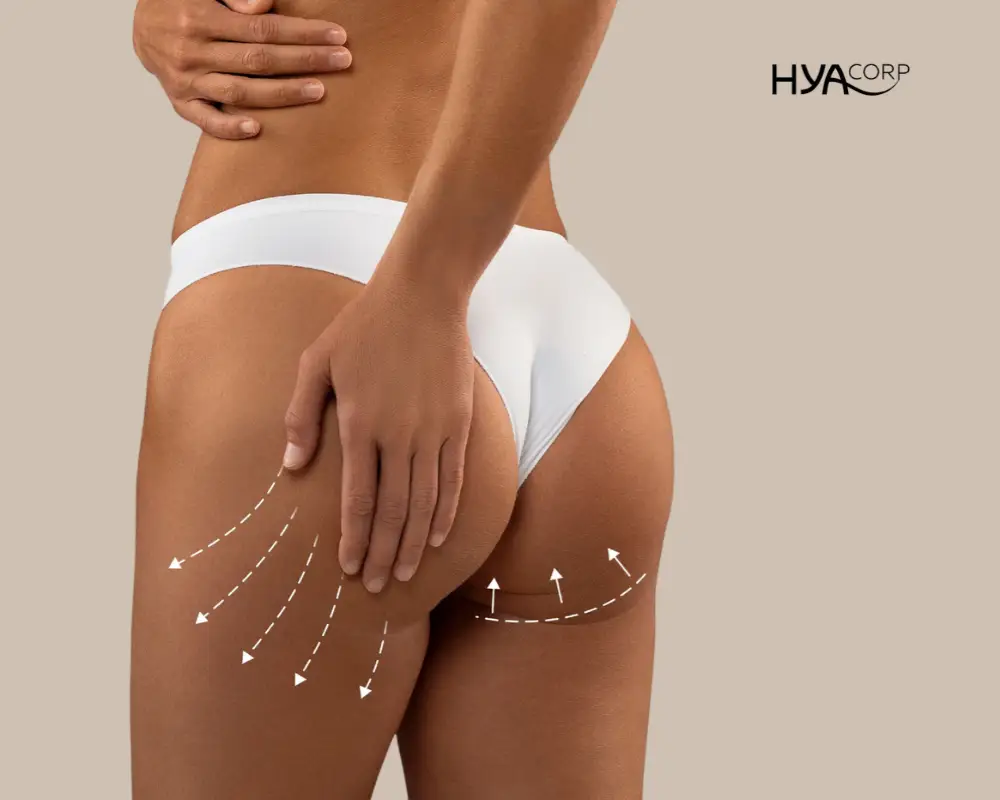




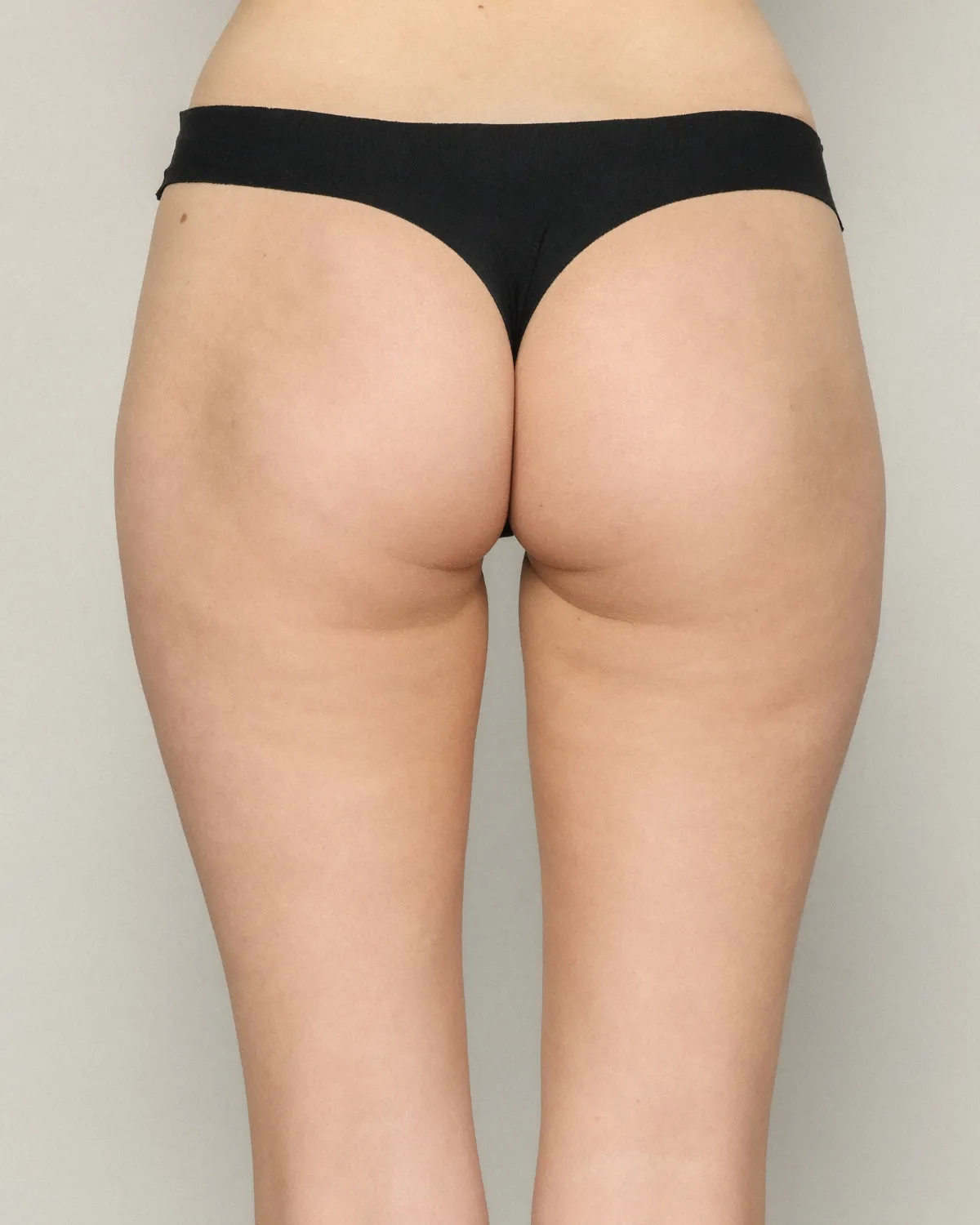

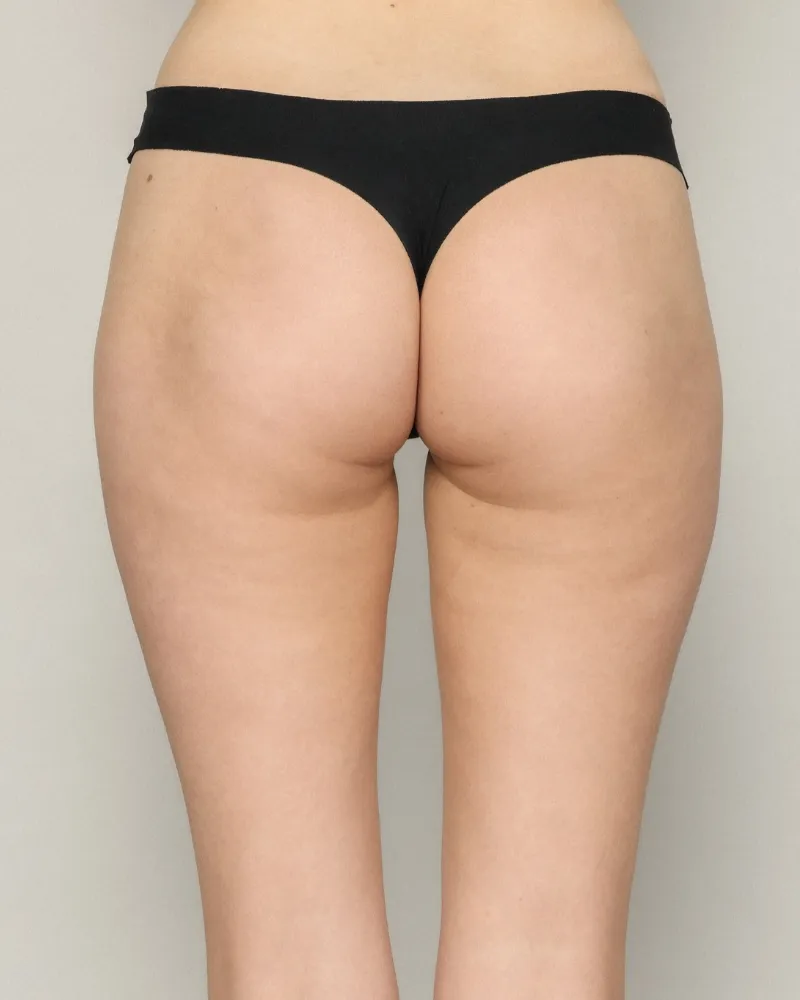
Hip dips are a completely natural part of body anatomy. For some people, they are barely noticeable. For others, the inward curve between the hip and upper thigh is more pronounced, regardless of how much they exercise or how their body weight changes.
As interest in non-surgical hip dip correction has grown, so have the claims surrounding it. Social media transformations can make hip dip fillers look like an instant solution capable of completely changing someone's body shape. At the other extreme, you may have heard that fillers cannot make a meaningful difference to the hips at all.
The reality sits somewhere between these extremes.
Hyaluronic acid body fillers can add targeted volume to the hip dip area, helping soften depressions and create a smoother transition through the outer hip.1 But realistic results depend on your existing anatomy, the amount of correction required, the product used, and the expertise of the medical professional performing the procedure.
So, what can HYAcorp hip dip fillers actually achieve? Let's separate some of the most common myths from reality.
What Are Hip Dips?
Hip dips are the natural inward curves that can appear along the sides of the body, below the hip bone and above the upper thigh.
Their appearance is influenced largely by anatomy, including the shape and position of the pelvis and femur, as well as the distribution of muscle and fat around the area. This is why hip dips can look very different from one person to another.
They are not a medical problem, nor are they something that needs to be “fixed.”
However, some people may prefer a smoother or rounder outer-hip contour. For those patients, aesthetic body contouring with hyaluronic acid fillers can provide a non-surgical option for adding volume to the depression.1,2
Understanding that distinction is important because it leads directly to one of the biggest myths surrounding hip dips.
Myth 1: You Can Exercise Away Hip Dips
Reality: Exercise can change muscle development, but it cannot change your underlying bone structure.
Squats, lunges, and exercises targeting the gluteal muscles can help build and strengthen the surrounding muscles. Changes in muscle mass and body composition may make hip dips appear more or less noticeable in some people.
What exercise cannot do is reshape the pelvis or change the anatomical relationship between the pelvis and femur.
This explains why someone can be very active, have well-developed gluteal muscles, and still have visible hip dips.
For people specifically looking to add volume to the depression itself, hip dip filler offers a different approach. Instead of trying to change the underlying anatomy, filler is strategically placed to add volume where it is needed and create a smoother transition through the outer hip.
Myth 2: Hip Dip Fillers Completely Change Your Body Shape
Reality: Hip dip fillers enhance contour by adding targeted volume.
One of the most important parts of understanding realistic hip dip filler results is knowing what the procedure is actually designed to do.
The objective is not to replace your natural anatomy or create an entirely different body shape.
Hyaluronic acid filler can be placed within the hip dip to reduce the appearance of the depression, improve contour, and create a more continuous transition between the waist, hip, and thigh.1-3
How significant that change appears depends on factors including:
- The depth and width of the hip dip
- Existing body proportions
- Tissue characteristics
- Amount of filler used
- Product selection
- Placement and injection technique
- The patient's desired degree of correction
For one person, the goal may be a subtle softening of the hip dip, while another may require greater volumization to create the desired contour.
This is why hip dip filler before-and-after results should be viewed as examples of what can be achieved in individual patients, rather than a template for what every result will look like.
Myth 3: A Small Amount of Filler Is Enough for Everyone
Reality: There is no universal number of millilitres for hip dip correction.
“How many mL of filler do I need for hip dips?” is one of the most common questions surrounding the procedure.
There is no single answer.
The hips are significantly larger than facial treatment areas, and the amount of filler required depends on the patient's anatomy, the depth of the depression, and the degree of correction being planned.
For this reason, the required volume should always be determined during an individual consultation. There is no fixed maximum volume specifically for hip dip correction. For treatment of the gluteal area, including hip dip correction, buttock augmentation, or a combination of both, the total volume used per treatment session can be up to 150 mL.
The goal is not to use as much filler as possible. It is to use an appropriate amount, in the appropriate areas, based on the patient’s anatomy, proportions, and treatment goals.
Myth 4: Any Dermal Filler Can Be Used for Hip Dips
Reality: Body contouring creates very different demands from facial filler treatments.
The hip region is a large anatomical area exposed to movement and mechanical pressure from everyday activities such as walking, running, exercising, and sitting.
This is why a filler designed for a delicate facial indication is not automatically appropriate for body contouring.
HYAcorp body fillers are highly cross-linked, biphasic hyaluronic acid fillers specifically designed for augmentation and contouring of the gluteal area, including hip dip correction.
The larger particle size and a high HA concentration, together with high G’ make them suitable for volumizing larger areas where greater structural support is required.4 HYAcorp body fillers are supplied in a 10 mL syringe, reflecting the different volume requirements associated with body applications.
Product choice is therefore not simply about choosing a HA filler. It is about selecting a formulation designed for the anatomical area and the type of correction being performed.
Myth 5: HYAcorp MLF1 and MLF2 Are Interchangeable for Hip Dips
Reality: MLF1 and MLF2 have different properties and body-contouring roles.
Both HYAcorp MLF1 and HYAcorp MLF2 are biphasic HA body fillers, containing 2 mg/mL of non-cross-linked HA and 20 mg/mL of cross-linked HA, but they are not identical products.
HYAcorp MLF1 has a smaller particle size and is suited to more delicate contouring and smaller-volume or more superficial corrections.
HYAcorp MLF2 has a larger particle size and is designed for areas requiring greater volumization and structural support. For this reason, it requires injection into deeper subcutaneous layer.
While HYAcorp MLF2 is used for significant volume restoration in deeper layers, HYAcorp MLF1 is designed for more superficial corrections. Specifically for hip dip correction, MLF1 can be applied to address superficial irregularities, or combined with MLF2 at a deeper subcutaneous level when a greater volumizing effect is desired
Depending on the patient's anatomy and the treatment plan, a medical professional may determine how different products or techniques can be used to achieve the intended result.
The important point is that product selection should follow anatomy and treatment goals, rather than assuming every body filler performs the same function.
Myth 6: Hip Dip Filler Results Are Permanent
Reality: Hyaluronic acid body fillers are biodegradable and gradually break down over time.
HYAcorp is not a permanent filler. Its hyaluronic acid is biodegradable, meaning it is gradually broken down by the body. As this happens, the added volume and contour will progressively change.
HYAcorp body fillers can provide results for up to 18 months, although individual results vary.
Longevity can be influenced by factors such as:
- Amount of product used
- Area of injection
- Individual metabolism
- Lifestyle
- Movement and pressure in the treated area
- Injection technique
This is particularly relevant around the hips and gluteal region because these areas are exposed to frequent movement and mechanical loading.
Rather than thinking of 18 months as an exact expiry date, it is better understood as a potential duration. The filler does not suddenly disappear at a particular point; the result gradually evolves as the HA is broken down.
Myth 7: Hip Dip Fillers Give the Same Result as a BBL
Reality: These are fundamentally different approaches to body contouring.
Searches for a non-surgical BBL alternative or “liquid hip lift” often lead patients to hyaluronic acid body fillers, but the terminology can create unrealistic expectations.
A surgical Brazilian Butt Lift typically involves liposuction and transfer of the patient's own fat to alter gluteal volume and shape. Hyaluronic acid hip dip filler does not involve fat transfer or surgery.
Instead, it allows targeted volume to be added to specific areas such as hip dips and the gluteal region. This can be useful when the objective is to refine contours, soften depressions, or improve proportions without undergoing a surgical procedure.
The two procedures should therefore not be viewed as identical treatments with identical outcomes.
A consultation with a qualified medical professional is essential for understanding which approach is appropriate for the amount and type of correction you are seeking.
Myth 8: Non-Surgical Means Risk-Free
Reality: Hip dip fillers are minimally invasive, but they are still medical procedures.
Avoiding surgery does not mean avoiding every potential side effect or complication.
Temporary swelling, tenderness, or bruising can occur following injections. Other adverse events, including infection, nodules and allergic responses, are also possible with dermal filler procedures.
Because hip dip correction involves larger volumes and a complex anatomical region, practitioner expertise is particularly important.
Your medical professional should understand body anatomy, appropriate injection planes, product characteristics and the techniques required for safe and effective placement.
Before undergoing HA body injections, discuss your medical history, previous aesthetic procedures, expectations, and potential risks with your practitioner.
Choosing the right practitioner is just as important as choosing the right product.
Myth 9: Hip Dip Filler Results Should Look Dramatic
Reality: Successful body contouring is about proportion, not simply adding maximum volume.
Social media can create the impression that the purpose of hip dip correction is always to produce a dramatic hourglass transformation, but it does not have to be.
The goal is much more subtle for most patients: softening a visible indentation, balancing asymmetry, or creating a smoother transition between existing contours. The appropriate degree of correction depends on the individual.
This is why a good consultation should focus not only on how much volume can be added, but also on how that volume will interact with the waist, hips, thighs, and gluteal region as a whole.
With HYAcorp, the objective is targeted volumization that complements the patient's anatomy rather than treating the hip dip as an isolated area.
What Can You Realistically Expect From HYAcorp Hip Dip Fillers?
Once the myths are stripped away, the role of HYAcorp for hip dips becomes much clearer.
It is designed to add volume to the outer-hip depression and help create smoother, more balanced contours without surgery.
Results are visible following treatment, although the initial appearance can be affected by temporary swelling, and the area should be given time to settle.
HYAcorp is specifically formulated for larger-volume body applications and can provide results for up to 18 months. It is not permanent, and the exact volume required or degree of correction achievable will differ from one patient to another.
Most importantly, the quality of the result depends on more than just the filler itself.
Anatomical assessment, realistic expectations, appropriate product volume, and precise injection technique all contribute to an outcome that works with the patient's natural proportions.
The Reality of Hip Dip Correction Is More Individual Than Social Media Suggests
There is no universal “ideal” hip shape, and having hip dips does not mean there is something wrong with your body.
For those who do choose to change their outer-hip contour, the most useful question is not whether a particular before-and-after transformation can be copied. It is what can realistically be achieved with your anatomy, proportions, and aesthetic goals.
That is where a body-specific approach matters.
HYAcorp provides medical professionals with a HA body filler designed specifically for larger-volume contouring, allowing hip dip correction to be planned around the individual rather than a one-size-fits-all result.
Considering hip dip fillers or want to learn more about HYAcorp? Contact us to learn more about HYAcorp and connect with the appropriate team in your country.
REFERENCES:
- Lourenco L, Medeiros H, Ferreira L, Favoretto Dias de Oliveira N, Lopes R, Sigrist R. Hip dips technique: Filling lateral depressions with hyaluronic acid of large particles. Skin Health Dis. 2024;4(6):e461.
- Crabai P, Marchetti F, Santacatterina F, Fontenete S, Galera T. Nonsurgical Gluteal Volume Correction with Hyaluronic Acid: A Retrospective Study to Assess Long-term Safety and Efficacy. Plast Reconstr Surg Glob Open. 2024;12(5):e5792.
- Fantozzi, F. Optimizing gluteal augmentation with hyaluronic acid: a comprehensive anthropometric study. Eur J Plast Surg. 2024;47:20.
- Fontenete S, Alfertshofer M. Rheological and Physicochemical Properties of Hyaluronic Acid Fillers for Body Contouring: Clinical Implications and Anatomical Considerations. J Cosmet Dermatol. 2026;25(2):e70553.
Frequently Asked Questions About Hip Dip Fillers
Do hip dip fillers actually work?
Hyaluronic acid body fillers can add targeted volume to hip dips, helping reduce the appearance of depressions and create a smoother outer-hip contour. The degree of correction depends on the patient's anatomy, amount of filler used, and treatment plan.
Can you exercise away hip dips?
Exercise can strengthen and build the muscles surrounding the hips and glutes, which may influence their appearance, but it cannot change the underlying shape of the pelvis. Hip dips are largely influenced by natural anatomy.
Which HYAcorp filler is used for hip dips?
HYAcorp MLF2 is specifically designed for larger-volume body contouring and is the primary HYAcorp product used for hip dip correction and gluteal contouring.
What is the difference between HYAcorp MLF1 and MLF2 for hips?
HYAcorp MLF1 has a smaller particle size and is suited to more delicate or superficial body corrections. HYAcorp MLF2 has a larger particle size and is designed for greater volumization and structural support, making it the primary product for hip dip correction.
How long do HYAcorp hip dip fillers last?
HYAcorp MLF2 can provide results for up to 18 months. Individual duration can vary depending on factors such as the amount of product used, area of injection, metabolism, lifestyle, movement, and injection technique.
Is hip dip filler permanent?
No. Hyaluronic acid hip dip fillers are temporary. HYAcorp MLF2 is 100% biodegradable and is gradually broken down by the body over time.
How many mL of filler are needed for hip dips?
There is no fixed amount of filler required for hip dip correction. The volume depends on the size and depth of the hip dips, individual body proportions, asymmetry, and the desired result.
For the gluteal area, up to 150 mL in total may be used per treatment session, whether the treatment involves hip dip correction, buttock augmentation, or both. The exact amount should always be determined by a qualified medical professional during an individual consultation.
Are hip dip fillers the same as a BBL?
No. A surgical BBL typically involves liposuction and fat transfer, while hyaluronic acid hip dip fillers add injectable volume to targeted areas without fat transfer or surgery. The procedures, recovery, and potential outcomes are different.
Are HYAcorp hip dip fillers safe?
HYAcorp MLF2 is a CE-marked hyaluronic acid body filler intended for professional use. As with any injectable medical procedure, side effects and complications can occur. Appropriate patient selection, product use, and treatment by a qualified medical professional are important for safety.
What are the possible side effects of hip dip fillers?
Temporary swelling, bruising and tenderness can occur following treatment. Other adverse events, such as infection, bleeding or allergic responses, are also possible. Potential risks should be discussed with a qualified practitioner before treatment.
How soon can you see results after hip dip fillers?
Added volume and changes in contour can be visible following the procedure. However, temporary swelling and other post-injection effects may influence the initial appearance, so the result should be allowed to settle according to the practitioner's guidance.
Do hip dip fillers look natural?
Hip dip fillers can be used to create subtle or more noticeable contour changes depending on the patient's anatomy and goals. Appropriate product volume and placement are important for creating smooth transitions that complement the surrounding body proportions.
Can hip dip fillers correct asymmetry?
Hyaluronic acid body fillers can be used to add targeted volume where asymmetry is present. Because natural asymmetry varies between patients, each side should be assessed individually and the treatment planned accordingly.