



Body contouring is no longer limited to surgery. For people looking to enhance certain contours, restore volume, or address specific areas without undergoing a surgical procedure, hyaluronic acid body fillers offer a minimally invasive option.
But getting fillers is not a decision that should begin with choosing a shape or deciding how many millilitres you want.
The product being injected, the area being treated, your anatomy, the qualifications of your practitioner and the treatment plan all matter. Body filler treatments can involve considerably different volumes, techniques and anatomical considerations from facial filler treatments, which makes proper assessment especially important.
So, before booking a non-surgical body contouring treatment, here is what you should know.
What Are Body Fillers?
Body fillers are injectable products used to restore volume, refine contours, or enhance specific areas of the body without surgery.
One option is hyaluronic acid fillers. Hyaluronic acid, commonly known as HA, is a substance naturally present in the human body and is widely used in aesthetic medicine. When formulated as an injectable gel, it can be placed strategically within appropriate tissue planes to create or restore volume.
Depending on the product and its intended indication, fillers may be considered for areas such as:
- Hip dips
- Buttocks
- Calves
- Hands
- Certain concave deformities or contour irregularities
Unlike surgery, treatment with body fillers does not involve surgical incisions or permanent implants. However, it is still a medical procedure and should only be performed by an appropriately qualified and trained healthcare professional.
How Do Hyaluronic Acid Body Fillers Work?
HA body fillers work by introducing a hyaluronic acid gel into selected areas to provide volume and support.
The important distinction is that not every HA filler is designed to perform the same way.
Think about the difference between treating a fine facial line and adding or restoring volume to a larger body contour. The amount of product required, depth of placement, and physical properties expected from the gel can be very different.
This is why the question should not simply be, “Which filler should I get?”
It should be:
“Which product is designed for the area I want to treat?”
That distinction becomes particularly important when comparing hyaluronic acid filler for the body vs the face.
Body Fillers vs Facial Fillers: Is There a Difference?
Yes.
Although both may contain hyaluronic acid, fillers can differ significantly in their formulation, particle size, rheological properties, intended injection depth, and approved indications.
Body areas can require greater volumization and structural support than many facial indications. Using a product specifically designed for the intended treatment area is therefore an important part of treatment planning.
HYAcorp, for example, includes biphasic hyaluronic acid fillers specifically developed for body contouring. In a biphasic gel, selectively sized particles of cross-linked HA are suspended within non-cross-linked HA.
Within the HYAcorp range, different formulations are available for different treatment requirements rather than using one product for every body area.
Your injector should determine which product is appropriate based on your anatomy, treatment area and desired outcome.
What Areas Can Be Treated With Body Fillers?
The appropriate treatment area depends on the filler being used and its intended indications.
With HYAcorp body fillers, applications include areas such as the buttocks, hip dips, calves, hands and concave deformities.
Hip Dip Filler
Hip dips are natural inward curves between the hip and upper thigh. For people who want to alter the appearance of this transition, HA filler may be used to add targeted volume and create a different contour.
The amount required for hip dip filler cannot be determined through a standard number online. It depends on factors including your existing anatomy, the degree of correction being considered, the treatment area, and the practitioner's treatment plan.
Non-Surgical Buttock Contouring
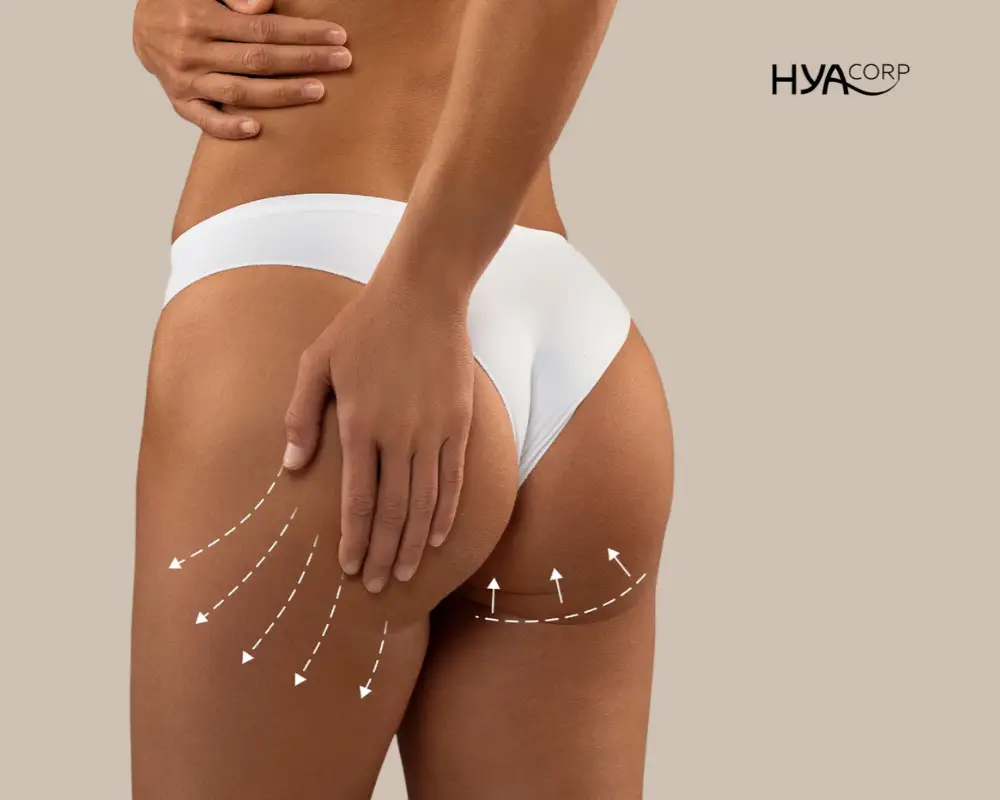
Hyaluronic acid filler can also be used for augmentation and contouring of the gluteal area.
Sometimes described online as a non-surgical butt lift, filler-based buttock contouring is different from surgical augmentation. Rather than undergoing surgery or receiving an implant, an appropriate HA filler is strategically injected to add volume and modify contour.
Calf Augmentation With Filler
For suitable patients, calf augmentation filler can be used to reshape or restore volume to the calves. HYAcorp MLF1 is specifically indicated for calf reshaping as well as other smaller body corrections.
Hand Rejuvenation Fillers
Volume changes in the hands can make underlying structures appear more visible over time. Hand rejuvenation fillers can be used to restore volume and improve the appearance of the hands.
A consultation is necessary to determine whether filler is appropriate for the area and concern you would like to address.
Choosing the Right Body Filler: Why the Product Matters
Choosing fillers should involve more than recognising a familiar brand name.
A qualified injector should consider whether the product is intended for the body, its formulation, its intended injection depth, the amount of volume required, and the specific area being treated.
HYAcorp has two dedicated cross-linked HA products within its body-contouring range: HYAcorp MLF1 and HYAcorp MLF2.
What Is the Difference Between HYAcorp MLF1 and MLF2?
HYAcorp MLF1 is a biphasic, cross-linked HA body filler intended for contouring and volumizing smaller areas. Its applications include hands, calves, and correction of concave deformities.
HYAcorp MLF2 has a larger particle size and is designed for larger-volume body contouring, particularly augmentation and contouring of the gluteal area.
The distinction is important because effective treatment planning is not simply about adding more filler. It is about selecting an appropriate product for the intended indication and using it correctly.
In some treatment plans, different products may also be used together based on the patient's anatomy and the areas requiring correction.
The right choice between HYAcorp MLF1 and MLF2 depends on the treatment area, the level of correction required, and your individual anatomy, making a personalised treatment plan an important part of the process.
How to Choose a Qualified Doctor for Body Fillers
The person performing your treatment is just as important as the product being injected.
Filler injections require an understanding of anatomy, appropriate injection planes, product characteristics, and the management of potential complications. Look for an appropriately licensed and qualified cosmetic doctor or aesthetic medicine practitioner who has specific training and experience in injectable body contouring.
During your consultation, ask about their experience treating the particular area you are considering.
Useful questions to ask before getting body contouring injections include:
- What qualifications and training do you have in injectable body contouring?
- How frequently do you perform this treatment?
- Which product will you use and why is it suitable for this area?
- What results are realistic for my anatomy?
- What are the potential side effects and complications?
- What should I do before and after treatment?
- What happens if I experience a complication?
- Is a follow-up appointment included?
A responsible healthcare professional should also be willing to tell you when filler is not the appropriate treatment for your goals.
Precautions to Take Before Getting Body Fillers
Preparation should begin with a medical consultation.
Your injector needs to assess your medical history, current medications, previous aesthetic procedures and the area being treated before deciding whether treatment is appropriate.
They should provide specific pre-treatment instructions based on your circumstances.
General HYAcorp pre-treatment guidance includes avoiding certain topical products and hair-removal methods around the treatment area shortly before treatment and avoiding alcohol the day before the procedure.
Some medications and supplements can also affect bruising or bleeding. However, do not stop prescribed medication without speaking to the healthcare professional who prescribed it.
Most importantly, follow the individual instructions given by your treating practitioner rather than relying solely on general advice found online.
What Happens During a Body Filler Treatment?
The exact process depends on the treatment area, product, and individual treatment plan.
Typically, your injector will first assess your anatomy and discuss the outcome you are hoping to achieve. The area may then be marked to establish the planned injection points and contours.
The filler is placed into the appropriate tissue plane using a technique selected by the professional.
Treatment time varies according to the area and volume being treated.
You may notice a change in contour immediately, although swelling and other temporary post-treatment effects can influence how the area initially appears. The final result should therefore be assessed according to the follow-up timeline provided by your injector.
Are Body Fillers Painful?
Discomfort varies between individuals and according to the area being treated, injection technique and volume used.
Patients may experience sensations such as pressure, tenderness or discomfort during and immediately after the procedure. Your practitioner can explain what pain-management measures may be appropriate for your specific treatment.
If you are concerned about pain, discuss it during your consultation rather than waiting until the day of treatment.
Body Filler Side Effects and Safety: What Should You Know?
All injectable medical procedures carry potential risks.
Temporary reactions following HA filler treatment can include swelling, redness, tenderness, bruising or discomfort around the injection area. Other complications are possible, including uncommon but potentially serious complications associated with injectable fillers.
This is one of the reasons body filler safety depends on more than the formulation itself.
Safe treatment depends on several factors working together, including selecting the right patient, using the right product, ensuring the right indication, applying the correct injection technique, and being treated by the right medical professional.
HYAcorp fillers are CE-marked medical devices and are manufactured from hyaluronic acid of non-animal origin. HYAcorp products are also biodegradable and produced under controlled quality standards.
However, a high-quality product does not replace appropriate medical practice. Product selection, anatomical knowledge, sterile technique, injection technique and appropriate patient assessment remain essential.
Always discuss the complete risk profile, contraindications and potential complications with your healthcare professional before treatment.
What Should You Avoid After Body Filler Treatment?
Aftercare can vary depending on the area treated and the technique used, so your practitioner's instructions should always take priority.
General HYAcorp aftercare guidance includes temporarily avoiding strenuous exercise, intense heat and excessive pressure on the treated area.
Depending on the treatment, you may also get specific instructions regarding taping, showering, massage, clothing, sleeping position or physical activity.
Do not massage or manipulate the area unless your practitioner specifically instructs you to do so.
If you experience symptoms that concern you or anything that has been identified as a warning sign, contact your treating medical professional promptly.
READ NOW – The Do’s and Don’ts of Body Fillers: A Smart Guide to Better Results
How Much Downtime Is Needed After Body Fillers?
One reason patients consider non-surgical body contouring is that it generally involves minimal downtime compared to surgical body-contouring procedures.
Some patients may return to parts of their usual routine relatively quickly, but that does not mean there are no post-treatment restrictions.
Swelling, tenderness or bruising can occur, and activities such as strenuous exercise may need to be temporarily avoided. Recovery also varies according to the treatment area and extent of the procedure.
If you have an important event, holiday or physically demanding activity planned, tell your practitioner during the consultation so that your treatment can be scheduled appropriately.
How Long Does HYAcorp Body Filler Last?
Hyaluronic acid fillers are temporary and gradually break down over time.
HYAcorp MLF1 and HYAcorp MLF2 are currently described as providing results for up to 18 months, although individual results vary.
Longevity can be influenced by several factors, including:
- The treatment area
- Amount of product used
- Patient metabolism
- Lifestyle
- Movement in the treated area
- Injection technique
Areas exposed to greater movement or pressure may behave differently from less active areas.
This is why asking “How long does HYAcorp filler last?” does not have one guaranteed answer for every patient.
Your injector can give you a more relevant expectation after assessing your treatment area and individual circumstances.
Body Contouring Should Start With the Right Questions
It is easy to approach aesthetic treatment by focusing on the end result: smoother hip contours, additional volume, reshaped calves or rejuvenated hands.
But a well-planned treatment starts earlier.
It starts with understanding what you want to change and why. It means choosing a qualified medical professional, discussing whether filler is appropriate for your anatomy, and making sure the product being used is designed for the intended area.
HYAcorp offers dedicated hyaluronic acid fillers developed for different body-contouring needs, giving practitioners options for both targeted corrections and larger-volume contouring.
Considering body fillers and want to learn more about HYAcorp? Contact us to find out more about HYAcorp treatments and connect with the appropriate team in your country.
Frequently Asked Questions About Body Fillers
What are body contouring fillers made of?
Body fillers can be made from different materials. HYAcorp fillers are made using cross-linked hyaluronic acid of non-animal origin. HYAcorp MLF1 and MLF2 are biphasic HA gels in which cross-linked HA particles are suspended within non-cross-linked hyaluronic acid.
Are body fillers the same as facial fillers?
Not necessarily. Although both may use hyaluronic acid, products can differ in formulation, particle size, physical properties, intended injection depth and approved indications. HYAcorp MLF1 and MLF2 are specifically designed for body-contouring applications.
Is HYAcorp body filler safe?
HYAcorp fillers are CE-marked medical devices manufactured according to defined quality and safety standards. However, every injectable treatment carries potential risks. Safety also depends on appropriate patient selection, correct product use, injection technique, and treatment by a qualified medical professional.
How long does HYAcorp body filler last?
HYAcorp MLF1 and MLF2 are described as offering results for up to 18 months. Actual longevity varies depending on the patient, treatment area, amount injected, lifestyle, metabolism, and other factors.
How many mL of filler are needed for hip dips?
There is no standard amount of filler required for hip dips. The volume depends on individual anatomy, the size of the area, the degree of correction required, the product being used and the overall treatment plan. An appropriate volume should be determined following an individual consultation with a qualified practitioner.
What is the difference between HYAcorp MLF1 and MLF2?
HYAcorp MLF1 is intended for smaller-volume body applications such as calves, hands and concave deformities. HYAcorp MLF2 has a larger particle size and is intended for larger-volume applications, particularly augmentation and contouring of the gluteal area. Your practitioner should select the appropriate product based on the indication and treatment plan.
How long is the recovery time after non-surgical body contouring?
Recovery varies according to the area and extent of treatment. Fillers generally involve less downtime than surgery, but temporary swelling, bruising, or tenderness may occur, and certain activities may need to be avoided during the initial recovery period.
How do I choose a qualified doctor for body fillers?
Check that the practitioner is appropriately licensed and trained in aesthetic medicine and has specific experience with injectable body contouring. Ask about their knowledge of the treatment area, the product they intend to use, expected outcomes, possible complications, aftercare, and their protocol for managing adverse events.
Are HYAcorp body fillers permanent?
No. HYAcorp MLF1 and MLF2 are hyaluronic acid-based fillers and are 100% biodegradable. The body gradually breaks down the material over time, so results are temporary.
Is there downtime after HYAcorp treatment?
Downtime varies between patients and treatment areas. Some people may resume normal daily activities relatively quickly, but your practitioner may recommend temporarily avoiding exercise, heat, pressure or other activities after treatment. Always follow the aftercare instructions provided for your individual procedure.

.webp)