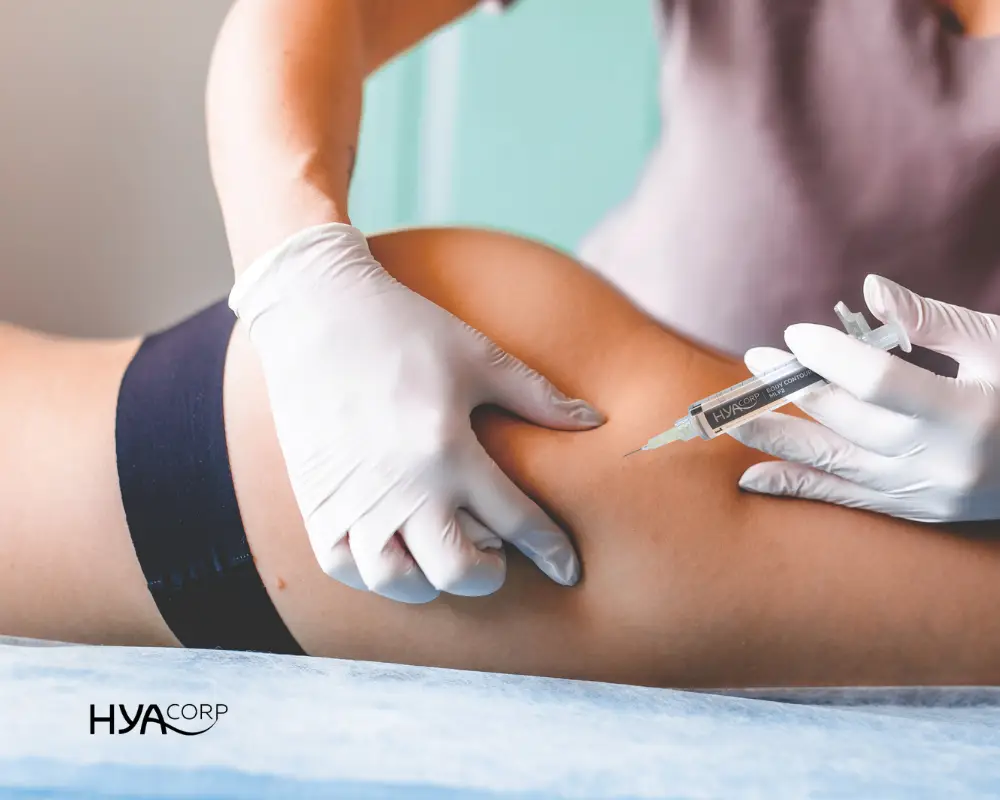
In 2026, aesthetic medicine is moving into a more refined era. The goal is no longer simply to add volume or create a dramatic transformation. Today, patients are looking for balance, proportion, natural-looking contours, and results that feel aligned with their silhouette.
This shift has created a new standard in body contouring: precision-led aesthetics.
Precision-led results are not about exaggeration. They are about control, balance, and anatomical harmony. They focus on correcting asymmetry, refining irregularities, restoring proportion, and supporting a result that looks intentional rather than obvious. For practitioners, this means selecting products that offer more than volume. It means working with injectable body fillers that support control, tissue compatibility, safety, and predictable outcomes.
This is where HYAcorp plays an important role.
As a line of hyaluronic acid body fillers by BioScience GmbH, HYAcorp is designed specifically for the body, with a strong focus on high-volume contouring, structural support, and refined correction. Its biphasic HA technology, high particle size, and body-specific formulations make it a trusted option for practitioners looking to address areas such as the hip dips, buttocks, calves, hands, and concave deformities.
Refining the Silhouette: More Than Just Volume
Body contouring is often associated with enhancement, but some of the most meaningful aesthetic outcomes come from correction.
Many patients are not necessarily looking for a larger or more dramatic silhouette. They may be seeking smoother contours, better proportion, or correction of natural asymmetry. Others may want to address irregularities caused by previous procedures, weight fluctuations, aging, or volume loss in specific areas.
These concerns require a precise approach and a smart treatment plan.
Correcting irregularities, smoothing skin depressions, and refining asymmetry are not about placing large amounts of product. They require careful assessment, anatomical understanding, and a filler that allows the practitioner to work with control.
Corrective body contouring requires more than simply adding volume. It depends on understanding how each treatment area moves, how much structural support it needs, and how the filler behaves once placed in the tissue. This is why product engineering matters. The ability to refine smaller areas, support larger contours, and adapt treatment to their natural anatomy is what separates basic volume enhancement from precision-led contouring.
Why Rheology Matters in Corrective Body Contouring
In aesthetic medicine, the way a filler behaves inside tissue is just as important as the volume it provides.
Rheology refers to how a gel flows, holds structure, responds to pressure, and integrates within tissue. For body filler treatments, this is especially important because the treated areas are often exposed to movement, pressure, and daily mechanical stress.
The filler must be able to provide volume, but it must also remain stable enough to support the intended shape. It should allow smooth injection, precise placement, and controlled correction without compromising the natural feel of the result.
HYAcorp’s Advanced Thixotropic Technology supports this balance. This allows the gel to return to its original viscosity after being spread from the syringe, supporting both injectability and structural performance.
For practitioners, this can support more controlled placement. For patients, it can help create results that feel refined, natural, and suited to the body’s contours.
Biocompatibility and the Science of Safety
Safety is no longer a supporting message in aesthetic medicine. It is a central part of the conversation.
Patients are more informed than ever about aesthetic treatments. They want to know what is being injected, how the product behaves, whether it is temporary or permanent, and what options exist if adjustments are needed. Practitioners, in turn, are looking for medical-grade injectables that align with modern filler safety standards.
Another important factor is biodegradability. Unlike permanent materials, HA-based fillers are temporary and gradually break down over time. This allows treatment plans to evolve as the patient’s silhouette, goals, and anatomy change.
For many patients, this is reassuring. Aesthetic goals are not fixed forever. The body changes with age, lifestyle, weight fluctuation, and hormonal shifts. A temporary, bio-absorbable filler offers flexibility, making it suitable for personalized treatment plans and long-term aesthetic management.
The HYAcorp Ecosystem: Specialized Engineering for the Body
Not all fillers are created for the same purpose.
While many injectable fillers are made with hyaluronic acid, the body has very different needs from the face. These areas often require more volume, stronger support, and greater resistance to movement and pressure. This is why choosing the right product for the right area matters.
HYAcorp is a specialized line of hyaluronic acid fillers designed for body contouring, volume restoration, and corrective refinement. Made with non-animal origin hyaluronic acid, the range is described as biocompatible and developed to support tissue compatibility, predictable performance, and professional use in modern aesthetics.
Its biphasic gel structure contains selectively sized particles of cross-linked HA suspended in non-cross-linked HA, which acts as a carrier. This structure helps support particle stability, projection, lifting effect, and longer-lasting contouring outcomes. HYAcorp’s CE mark approval, along with ongoing testing and quality inspections, further supports its safety and quality positioning.
This distinction matters because the body is not one uniform treatment area. A hip dip correction does not require the same approach as hand rejuvenation. A post-surgical indentation does not need the same strategy as gluteal enhancement. By offering different particle sizes and rheological characteristics, HYAcorp allows practitioners to choose a product based on the treatment area, tissue depth, volume requirement, and aesthetic goal.
HYAcorp MLF1: Subtle Refinement for Smaller Areas
HYAcorp MLF1 is designed for smaller areas of the body. It is commonly positioned for volumization and correction of the calves, hands, and concave deformities. Its particle size of 200 - 350 μm makes it suitable for more delicate contouring and corrective refinement.
This makes MLF1 especially relevant for cases where the goal is not high-volume enhancement, but smoother transitions, improved contour, and subtle correction.
HYAcorp MLF2: Structural Support for Larger Areas
HYAcorp MLF2 is designed for larger-volume body contouring. It is a highly cross-linked body filler used to augment and contour the gluteal area. Its larger particle size of 300 - 500 μm supports its use in bigger indications such as gluteal enhancement and hip contouring.
For practitioners, this difference between MLF1 and MLF2 allows for more tailored product selection. Instead of applying a one-size-fits-all approach, treatment can be planned according to anatomy, mobility, volume requirement, and correction goal.
Proactive Care: Managing the Unpredictable
Every responsible conversation about fillers should include safety and complication management.
Even with experienced practitioners, aesthetic treatments require careful planning, anatomical knowledge, and appropriate product selection. The goal is always to minimize risk, but professional integrity also means being prepared to manage the unexpected.
One advantage of HA-based fillers is that they offer a level of flexibility that permanent materials do not. In clinical practice, hyaluronidase may be used by qualified professionals to break down hyaluronic acid filler when medically appropriate. This does not mean treatment should be taken lightly, but it does provide an important management option that is not available with permanent fillers. This is especially relevant in revision aesthetics.
Patients who have experienced irregularities, asymmetry, or dissatisfaction from previous treatments may need a careful corrective approach. In these cases, the practitioner’s skill is just as important as the product used. Ultrasound-guided injections, detailed anatomical assessment, and proper patient selection are increasingly becoming part of modern filler safety standards.
For HYAcorp, the value lies in being part of a professional treatment strategy. It is not just about injecting volume but also about using a medical-grade HA filler in the right indication, with the right technique, by a trained practitioner.
Restoring Confidence, One Correction at a Time
Behind every aesthetic treatment is a human reason.
A patient seeking hip dip correction may not be looking for a dramatic change. They may simply want their silhouette to feel more balanced in clothing. Someone with post-liposuction irregularities may want smoother contours after a procedure that did not heal as evenly as expected. A patient with volume loss in the hands or calves may want to restore proportion in a way that feels natural and personal.
These are not superficial concerns. They can influence how a person feels in their body, how they move through social moments, and how confident they feel in daily life. This is why precision in aesthetic treatment matters.
A small correction can make a visible difference. A smoother transition between areas can create better harmony. A subtle adjustment can help the silhouette look more balanced without looking overdone.
HYAcorp supports this modern approach to body contouring by giving practitioners specialized tools for personalized treatment planning. Whether the goal is gluteal enhancement, hip dip correction, calf refinement, hand rejuvenation, or smoothing irregularities, the focus remains the same: precision, proportion, and patient-centered results.
The Future of Body Contouring Is Personalized
The future of aesthetic medicine is not about one standard look, but rather, personalization.
Patients want results that suit their anatomy, not trends that make everyone look the same. Practitioners are moving toward evidence-based aesthetics, where treatment decisions are guided by anatomy, product behavior, safety, and long-term planning.
This is exactly where HYAcorp continues to stand out.
With a specialized body filler ecosystem, biphasic HA technology, Advanced Thixotropic Technology, and formulations designed for different areas, HYAcorp gives practitioners the ability to approach body contouring with more strategy and control.
In 2026, the strongest results are not the most obvious ones. They are the ones that look balanced, feel natural, and respect the individuality of the patient’s body. That is the new standard of precision-led contouring.
Ready to Restore Balance?
For patients, HYAcorp offers a non-surgical option for those seeking refined volume, smoother contours, and improved harmony. To understand whether injectable body fillers are suitable for your goals, connect with us, and we’ll guide you toward the right next step.
For doctors and aesthetic professionals, HYAcorp provides a specialized HA filler portfolio developed for precision-led body treatments, corrective refinement, and patient-centered planning.
Contact us today to learn how HYAcorp can support your aesthetic goals, clinical approach, or advanced body contouring practice.
FAQs:
What is hyaluronic acid?
Hyaluronic acid (HA) is a naturally occurring substance found in the body. In aesthetic medicine, HA is used in dermal fillers to support volume, hydration, and contouring.
What are HA fillers and how do they work?
HA fillers are injectable gel-like products used to restore volume, refine contours, smooth depressions, and support facial or body harmony. They work by being placed beneath the skin or within targeted tissue planes by a qualified practitioner.
Is HYAcorp safe?
HYAcorp is a CE-marked line of hyaluronic acid fillers with formulations designed for body contouring, volume restoration, and corrective refinement. Like all injectable treatments, safety depends on correct product selection, appropriate technique, anatomical knowledge, and treatment by a trained medical professional.
Is HYAcorp permanent?
No. HYAcorp is an HA-based filler and is not permanent. It is designed to be gradually broken down by the body over time.
How long do HYAcorp results last?
HYAcorp MLF1 and HYAcorp MLF2 are described by the brand as offering results of up to 18 months, although individual results may vary depending on the treatment area, patient metabolism, lifestyle, and technique used.
Can HYAcorp fix irregularities from previous surgeries?
HYAcorp MLF1 is positioned for volumization and correction of calves, concave deformities, and hands. In suitable cases, HA body fillers may be used by trained practitioners to improve the appearance of depressions, asymmetry, or contour irregularities.
What is the difference between HYAcorp MLF1 and MLF2?
The main difference is particle size and treatment indication. HYAcorp MLF1 has a particle size of 200 - 350 μm and is designed for smaller areas such as calves, hands, and concave deformities. HYAcorp MLF2 has a larger particle size of 300 - 500 μm and is designed for larger-volume areas such as the gluteal region.
Can facial fillers be used on the body?
Facial fillers are not designed for the same structural demands as body fillers. Body areas often require higher volume, different rheological properties, and stronger support. HYAcorp body fillers are specifically designed for body contouring and volume restoration.
Is HYAcorp made with non-animal origin hyaluronic acid?
Yes, HYAcorp fillers are made with non-animal origin hyaluronic acid. This supports biocompatibility and aligns with modern expectations for cleaner, tissue-compatible filler formulations.
.webp)